There’s been a welcome shift in popular culture over what feels like the past 5-10 years, a recognition that the animated medium of storytelling shouldn’t just be relegated to children’s tales, something Japan recognized years ago. Not that there aren’t incredible family friendly animated stories like Disney’s Up that I’ll keep coming back to till the day I die. Or the recent Puss in Boots: The Last Wish. That movie has no right to be as good as it is. But I feel that my generation, or perhaps just myself, watched Avatar: The Last Airbender back in the mid to late 2000’s and then never stopped asking for animated tales that grew with us, tackling ever more mature topics with the ingenuity and openness drawn worlds can provide. Though I will say Avatar: The Last Airbender ages like that perfectly soft hoodie: it’s a comfort I’ll keep coming back to even as the DVD’s start to wear with use. And then I’ll just stream it. But as a millennial working hard at adulting, I’m grateful to see a profusion of complex, deep and dark tales sketched onto the screen. In the modern streaming landscape, it started for me with Castlevania. What an incredible show. Impressive worldbuilding and character depth along with insane fight scenes rivaling the best the medium has to offer. Since then we’ve gotten Arcane, Blood of Zeus, Blue Eye Samurai, The Legend of Vox Machina, and Invincible, just to name a few. This is before going into the influence of Japanese anime, a genre that isn’t without its overly indulgent fan service and myriad other, at times frustrating, quirks. But anime is nonetheless a seminal subset of the medium with entries I adore. Ghost in the Shell was a significant source of inspiration for my novel. Oddly enough so was the Studio Ghibli classic Spirited Away, even if it is quite a different setting and subject matter. But if there is any common thread in all of the aforementioned animated stories, it’s that they took advantage of the medium’s greatest strength: a blank canvas that doesn’t need to mesh real people with CGI to tell a fantastical tale through the lens of the mind’s eye. Scavengers Reign did that in spades, and then some.
I won’t give any spoilers for Scavengers Reign, but then again I’m not even sure I could spoil the greatest aspect of it in a written blog. The art is otherworldly and capricious and mysterious and stunning. The basic premise as could be found in any blurb for the show is that a space freighter named the Demeter has crash landed on an alien planet. That’s as much as I’ll say plot wise. The planet, with it’s unique and unfamiliar ecology, microcosms of life and death and everything between, sets the show apart. Along with the characters, you experience that which is both unsettling and beautiful. My only sadness is that the second season remains uncertain. First Max canceled the show not too long after it aired, then Netflix gave it a trial period to see if it warranted more episodes. Now who knows, though it does seem likely the first season is the end even with the Emmy nomination. Either way, it’s well worth a watch. It tells a complete story in it’s first and perhaps only season, even if I can’t help but hope we see the seeds planted for further adventures on that terrifying world bear fruit.
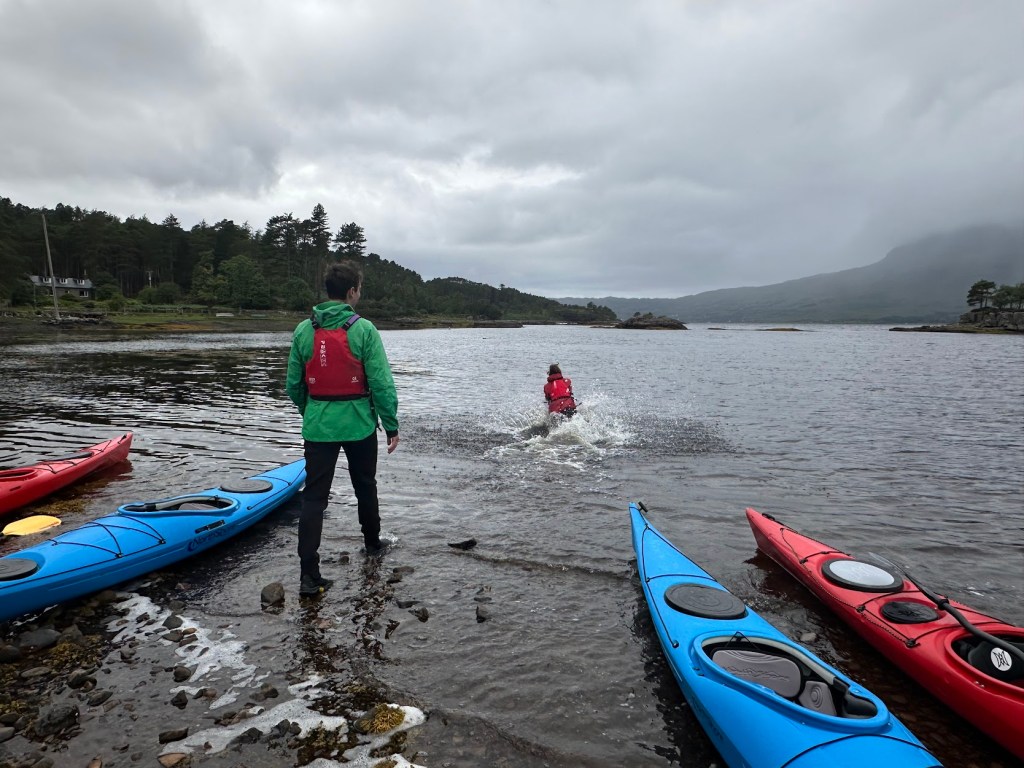
I’m in the airport on my way back to Colorado after finishing up a family vacation in Scotland. Figured I’d share a particular highlight. This is us after kayaking Loch Torridon in what may not look like good weather but was a welcome break from otherwise steady rain. I’m hesitantly following Courtney into what I promise you was very cold water. My parents and sister are behind the camera, understandably unwilling to take the plunge.
The amount of fun I’m having playing the video game Baldur’s Gate 3 reminds me of when I first played Dragon Age: Origins way back in 2009. BioWare seemed to have poured its collective heart and soul into developing DA: O back in the day, even if BioWare’s more recent entries have been a tad more hit or miss for me. I know I’ve put well north of a hundred hours and multiple playthroughs into DA: O. It truly felt like a tabletop roleplaying game akin to Dungeons and Dragons distilled into video game form. Its free use of a pause system made it’s combat turn-based adjacent, and the setting was one familiar to any fan of high fantasy with ample quirks and flairs to make it unique, a testament to David Gaider’s work. The companions were a particular highlight. I did a Morrigan romance in my main campaign. Who doesn’t love a shapeshifting witch of the wilds? Even if she did need a bit of an introduction to empathy. Pragmatic to a fault that one. I gotta give a shout out to my boy Alastair as well, ex-templar and rightful king. And Leliana. In any case, I seem to have gone a bit afield. Point is, as much fun as I had playing Dragon Age: Origins, Baldur’s Gate 3 seems to be eclipsing it.
All of the strengths I mentioned above with regards to DA:O are just as applicable to BG 3, with even more besides given BG 3 actually takes place in the D&D universe known as the Forgotten Realms. As someone who currently DM’s a weekly D&D campaign, Larian somehow managed to capture the most of elusive of things: the absolute chicanery and chaos that comes from a table of friends letting their imaginations run wild. The amount of leeway the developers give the players to sweet talk or intimidate or outwit only to have their plans quite rudely interrupted by a natural 1 rolling of the die resulting in unintentional murderhobo is D&D at its zaniest. I’m currently playing a longbow focused wood elf beast master ranger who sends his tanky bear Ursa into the fray while expertly cutting down marked prey from afar. Ursa is best bear and I can’t wait for Ursa to get an armored hat. The eternally gloomy Shadowheart, the earnest and unintentionally hilarious Lae’zel, and the loquacious yet distant mage Gale round out my typical crew. I’m in the middle of Act 1 and swap out Lae’zel for Wyll or Astarion depending on the questline. With how long it has taken me to get as far as I have, I can only imagine how many hours are going to get sunk into this game. Here’s to hoping I can stay productive with all the other things I want to do. And now, back to Baldur’s Gate to sneak into a goblin camp.
All the best,
M. Weald
P.S. I would be amiss not to mention that my character’s name is Cheeseburger. My first ever D&D character was a ranger named Cheeseburger with a wolf companion named Fries. My DM loved me…
If I’d been asked to pick my favorite author during high school, it probably would have been Stephen King. I read my fair share of his horror classics during this time: The Stand, The Shining, It, The Long Walk, Cell, Under the Dome, etc. I grew up amongst the corn fields of southern Indiana and something about this devil-at-the-crossroads Midwest pastiche demanded some flavor of emo out of pretty much everyone. For many that meant a long fringy black haircut, black clothes, black nail polish, skinny jeans, and a general air of existential fatalism. For my nerdy self, it meant reading Stephen King’s very specific style of the small town macabre well into the night … and long fringy brown hair, skinny jeans, and a penchant to listen to My Chemical Romance. All that aside, my favorite out of his many works has to be his era spanning fantasy epic: The Dark Tower Series. On those occasions when he dipped into the world of fantasy, his descriptions of the grim and gory melded with my earliest literary love of heroic fantasy to become something new to my young high school self. At the time, it felt like only those who truly liked Stephen King even knew of his Dark Tower novels, his magnum opus hidden behind his much better known aforementioned horror hits. I recall after finishing book 7 and closing the door on the story of gunslinger Roland Deschain, I searched through his bibliography hoping for more of the same. I found his book The Eye of the Dragon and read that right away. Soon after that the The Wind Through The Keyhole was published. Still, none of it’s ever quite fully scratched the itch. My reading habits are more varied, at least in terms of authors, these days, but I still keep an eye out for any new Stephen King release. Especially one of the fantasy variety. So, you can imagine my excitement when I heard tell of Fairy Tale.
With a name like Fairy Tale, I would have been sorely disappointed had it not included a fantastical, medieval adjacent realm filled with unknown magics needing to be set aright. Thankfully, the book well and truly followed through on the name’s promise. It is even told with the air of one sitting at a campfire, relaying an adventure of their past. In this case, the narrator is an older Charlie Reade, relaying his difficult childhood and subsequent journey to another realm. At this point, I’ll give a minor spoiler warning. Nothing major, just hints and clues and what’s already written on the back of the book. In any case, Fairy Tale lives up to its name. It is chock full of references to fairy tales from the particularly important Rumpelstiltskin all they way to a more modern fairy tale like The Wizard of Oz, and it follows the general arc of one well enough itself. It begins with a young Charlie Reade talking of that “goddamn bridge”, the site of his mother’s early death from being struck by a van. His father drinks to cope and loses himself for awhile, a young Charlie losing himself in acts of juvenile delinquency with his friend Bertie Bird. Eventually, Charlie’s father, George, gets sober with the help of a friend and an AA program. Charlie too, above all grateful for his father’s newfound sobriety (though not without his own scars and misgivings on his father’s past actions) gets on the straight and narrow. It is after a bit of time on this road of recovery we see young Charlie meet an injured Mr. Howard Bowditch and his dog Radar. Let’s just say Howard is a taciturn old man with secrets aplenty and Radar his aging German shepherd whom Charlie immediately recognizes as the goodest of bois (To put it another way that doesn’t use internet slang, he loves that dog right away). One of those pesky secrets of Howard’s includes a shed in the backyard, one from which occasionally emerges a rather disturbing noise. Since it is expressly written in the blurb of the book, I’ll describe this shed as akin to a certain wardrobe of fantastical renown. Through it, Charlie will go to another realm to learn a bit of wisdom, experience a bit of that Stephen King macabre, and return to the world a changed young man. If I had to pinpoint that bit of wisdom that Charlie learns, it would be the age old lesson that love can be a powerful thing. Oh, and names. Names can be powerful too. I give this book a hearty recommend.
P.S. In writing this post I realized I somehow completely missed the existence of King’s Dark Tower adjacent books The Talisman and Black House. So that’s a bit of egg on my face. And my TBR just got two books longer.
7/7/2024 Edit: Just to add a few words here. If I had to rank my all time favorite video games, both 2018’s God of War and 2022’s God of War Ragnarok would be in my top 5. Rounding out the rest (though in no particular order) would probably be Baldur’s Gate 3, Dragon Age: Origins, and maybe Mass Effect Legendary Edition. I recognize I cheated a bit there as the last one combines all 3 Mass Effect games (we don’t talk about Andromeda). So perhaps I should say all of these are in my top 10. Halo2 and 3 would be there as well. Witcher 3: Wild Hunt for sure. Maybe Fable 2. Star Wars Knights of the Old Republic. Morrowind or Skyrim. Last of Us (Can’t believe I almost forgot about that one). Last of Us Part 2 I have yet to play, though I will soon. The Uncharted games aren’t in my top 10, but they are up there no doubt. Same for the latest Tomb Raider reboots. Lost track of my count but that feels like around ten. Definitely a theme in my choices. I do like me a good RPG. In any case, if you haven’t played the recent God of War games, you really should give them a chance. Sometimes I think a good father son relationship is a topic underrepresented in today’s media. God of War addresses that, perceived or otherwise, scarcity with an incredible tale that all too often hit me with an emotional gut punch throughout its incredible set pieces and seamless cutscenes. Kratos learning to connect with his son after their mutual loss is a story I only wish I could experience for the first time once more. No matter, a revisit in the future will suffice.
As of this writing, I’ve watched a season and a half of Invincible, a show that, for me, has been one of the few antidotes to superhero fatigue post Marvel’s Avengers putting an end to Thanos (though the fatigue set in a bit before that if I’m being honest). Along with The Boys, it’s given the superhero genre a much-needed dose of gritty realism. With the second half of the second season of Invincible having been released recently, it felt like a good time to revisit what came before, prior to dipping my toes back into this gory, violent, fantastic, emotional gut punch of a story.
For anyone who hasn’t seen Invincible yet, I can give it a hearty recommendation. I don’t like the tendency that seems all the more common these days to compare everything to Game of Thrones. At worst, it’s a comparison without depth and just a way to grab eyeballs. I mean, don’t get me wrong, I get it. It’s convenient shorthand and I’m doing it here. But in this case, I do think a comparison is apt in one regard: few of the characters in Invincible feel without risk of an untimely death or an evil turn and the stakes are better for it. This sense of danger isn’t unique to Game of Thrones of course, but that story’s influence in bringing this “no one is safe” aspect of the grimdark genre into the mainstream is profound. Sometimes it is done well. Sometimes not. In the case of Invincible, I think it’s done well.
I suppose I should admit something first though. I haven’t read A Song of Ice and Fire (the Game of Thrones books). I know, I’m disappointed in myself too. My time has just been spent elsewhere. I’ll remedy that eventually no doubt. But oddly enough, the TV adaptation has actually held me back a bit from giving it a shot. Well, that and the fact it’s unclear to me whether the books will ever get finished. Absolutely no shade is meant to George R. R. Martin by me saying that. While I do think an author has a responsibility to readers to finish a story once begun, I also firmly believe authors have the right to do so in their own time and their own way. In any case, I watched all the episodes of the TV adaptation, though not without a few rage-quitting, favorite-character-dying induced breaks along the way (SPOILERS for Game of Thrones from here onwards. Thinking of Pedro Pascal’s character Oberyn Martell, and the Red Wedding, and Sean Bean’s Lord Eddard Stark, and … well … we’ll stop there before I get too sad). And now for my second admittance: I can only handle so much grimdark. I’m more of a fan of what I’m going to call grimgrey, if you will. It’s just my own personal preference, but it seems to me, if a story burns me too many times by taking characters I love and killing them off, or corrupting them, or showing they were corrupt all along, I pull back. A little to moderate amount of that, depending on the story being told, is good story telling, absolutely necessary even. But too much and I protect myself by calcifying my empathy, by telling myself not to care. What’s the point of caring about a character if terrible things, like getting their head crushed to a pulp due to a moment of arrogance, are just going to happen to them? Game of Thrones, the TV show, got that way for me. Of course, the heroes won out in the end, but that whole situation was marred by the lack of source material to keep the narrative aright. It didn’t feel earned in some ways, which was the worst of both worlds for me. It felt like the show just hurt me without adequate payoff. So, what’s all this got to do with Invincible anyway?
Everything. If you’ve seen the first episode, you know what I mean. Similar to Game of Thrones setting the tone early on by taking part in Hollywood’s favorite pastime and killing Sean Bean, Invincible sets the tone with a major twist towards the end of the first episode. This twist, well, I’ll admit it was almost too much for me at first. I’m a big old softy it seems. The final scene gave me flashbacks to pulling away from Game of Thrones. It took some time, but I eventually came back to Invincible through the urging of my girlfriend. And boy, am I glad that I did. The characters have a depth and feeling to them that would be lacking without the narrative as it is. At least so far, Invincible has dexterously managed the delicate tight rope of keeping it high stakes while keeping me invested. So, if you haven’t seen it, go give it a shot and come back later, cause now there be spoilers afoot.
Ok, Omni-Man. Mark’s dad. Nolan. Such a terrible person, but so well written. If the first season was about the unraveling of his façade, of Mark and his mother Debbie learning the truth of Omni-Man, the first half of the second season is about them processing the fallout. Tough to watch at times, in particular for Mark’s mom, but so effective. Debbie really needs a win, and I hope the newly released episodes deliver for her. The arc of her going to a therapy group for partners of dead heroes could only have ended as it did: with someone learning the truth. Her husband had been the source of so many of their losses. It hurt, but man did it make me feel for her even more, as if I wasn’t already a big fan. Such good writing. And Mark and his dad’s reunion … oof. I completely agreed with everything Mark said in that scene. Completely unfair of his dad to bring him there with unrealistic expectations. Utterly messed up that Nolan started a new family like that, but also completely in line with his character. Nolan was adrift, near suicide, and offered a chance to do good by the universe and did so, though not without benefiting himself in the process. He didn’t give proper thought to consequences and sired a child; Nolan is not a good person by any stretch and that shouldn’t be forgotten. But he’s also not a proper Viltrumite anymore, and that’s progress I suppose. I’m excited to see where the show goes next, I just hope it doesn’t lean too hard into the dark (why’d they have to do Allen the Alien like that???). I like my stories grey with an impactful, and generally optimistic, end.
All the best,
M. Weald
P.S. Currently in the midst of reading Stephen King’s Fairy Tale. It’s been too long since I last read any Stephen King. I think the last I read of his was that Bill Hodges detective series trilogy. Good to be back in a world of his creation. He is one of my all-time favorite authors and his infrequent dips into the fantasy genre have been some of my all-time favorite novels. Can recommend! Also, my YouTube channel has been a bit … derelict lately. Side effect of being busy. But I’m working on a Year of Sanderson post. Would give a timeline on that but would rather not jinx it.
Hey all. I got the Kirkus review for The Work of Restless Nights, and believe it or not there was nary a negative comment to be found! This one had me nervous, I’ll admit. The whole setup for self-published authors, any author really, is primed for inducing anxiety. You pay Kirkus a not so insubstantial amount of money and wait for a month or two to see what kind of review will emerge. Once available, you are given opportunity to read through the review and decide whether it will be shown the light of day or forever relegated to some forgotten server. If it had been the latter, I could only hope it would’ve been lucky enough to be stored next to the mothballed likes of Batgirl and Coyote vs. Acme. Thankfully, it has been released to the wild. It can be found here in its entirety: Kirkus Review. If you’re not wanting to read the whole thing, some highlights are below.
“The impressive debut of author Weald … The robot-uprising SF plotline is, literally, as old as robots in literature. The concept of a tech-soaked urban sprawl with overlay environments of virtual- and augmented-reality enjoyed by citizens wired directly into the digital mesh is cyberpunk 101. Weald does not radically reinvent such concepts, but thinks their aspects through with a seriousness of purpose and nuanced characterizations.Throughout, one finds the efforts of a serious literary novelist lavished on material that otherwise would fuel scores of sci-fi potboiler paperbacks and Japanese anime … Lengthy, immersive cyber-SF that puts fresh life into a familiar operating system.” – Kirkus Reviews
Definitely stoked! The full review shows that the reviewer really got my novel, really understood what I was trying to do, and I’m beyond grateful for that. I wanted to take familiar concepts, sci-fi/cyberpunk staples, and make them my own, think them through. Certainly the first time I’ve ever been associated with the term “serious literary novelist”. I’ll admit to myriad feelings arising from the “literary” connotation. I enjoy writing and consuming stories more often than not of what I would call the genre variety, a variety that has, at times, been maligned by certain holier than thou literary types. I got a minor in creative writing in undergrad, and one of my professors had a smidge of that prejudice, often wondering aloud why myself and another genre inclined hopeful needed, or even wanted, such fantastical elements to our stories. I think there was even a class whose discussion had turned to asking whether Stephen King could be allowed into the hallowed halls of the “literary” classification, whether academia could deign to bless him so, a discussion I find to be rather asinine. What is defined as “literary” changes over time given historical context and impact, along with the whims of the powers that be. Things that were considered populist at the time of release become literary years later, just look at Mary Shelley’s Frankenstein. Restricting high art or value to that of the literary world at any given moment is bound to make one look foolish in the end. I’m thinking of N.K. Jemisin’s Broken Earth Trilogy as another prime example of incredible genre fiction that should be included as literary if anything should. Suffice to say, problems arise when confusing value with subjective taste when it comes to stories. Stories are incredible in all their myriad forms, literary or genre or anything else. See my blog post In Defense of Genre (And Everything Else) for my thoughts there.
Anyway, if it wasn’t obvious, I’ve had a bit of a chip on my shoulder ever since that professor thought of my writing as lesser simply because it included fantastical elements. This review gave me that warm fuzzy feeling as a result. It was a much needed drink of water in my writing journey, a journey that often feels like wandering through a desert alone. Even so, I’ll also admit to it making me wonder about the value of the literary classification in its modern incarnation. If it is to denote a certain style, deep characterization or playful prose or a tackling of broader questions of humanity, fantastic. But if it is to assign value, I can do without. And it’s not like any of those descriptors are unique to the literary world anyway.
All that to be said, I feel incredibly lucky and grateful to have gotten this review.
First off, I’m a big fan of Brandon Sanderson. When I was young, so pretty much from grade school through early high school, I read incessantly. From the time I first picked up the likes of Deltora Quest, Ranger’s Apprentice, Harry Potter, Eragon, or any book with Drizzt Do’Urden in it, all the way to borrowing my older brother’s copies of Stephen King’s The Dark Tower series, it was hard to find me without a book in hand. But then I kind of … stopped for a bit. Or at least lessened the pace during the latter half of high school and the beginning of college. Part of this was because I finally started coming out of my shell. I was a nerdy kid emerging into an equally nerdy, but moderately more confident in himself, young man. And I started taking soccer more seriously, playing on different teams in high school year round and realizing I had at least a modicum of athletic ability. I didn’t play much soccer in college though. Early college has enough distractions without sports in the mix and I was a bit burnt out on it. I was an engineering student, so studies took up most of my time. But then of course there are the new and exciting social opportunities miles away from any parental guard rails. Granted, I mostly studied. I was and always will be a proud nerd. However, it’s also true I made lifelong friends and, in the … ahem … laudable quest of learning about myself and my place in the world around me, made my fair share of poor decisions. This included forever tarnishing the stench of Jägermeister after buying a handle and, well, I don’t remember much after that. All this to say, I was distracted from the safe haven books had provided me for years by a world I found myself wanting to explore in a more real way. I came back to books of course. Like hearing scraps of a forgotten lullaby and knowing only it made me feel safe, I would hear mention of fantasy or sci-fi stories and feel an urge to pause and listen. So I came back to fiction after a brief reprieve, and came back to an absolute banger: Mistborn by Brandon Sanderson. I love the first trilogy in that series in particular, Mistborn Era 1 as it’s also known. It sucked me in immediately, brought me back to earlier days where my form of rebellion was staying up too late reading. I tore through those books. I don’t think I got a good night’s sleep all through the back half of The Hero of Ages because I couldn’t put the thing down. Probably scored a bit lower on a few engineering exams as a result. It’s no exaggeration to say I wouldn’t have gotten a creative writing minor, and wouldn’t have written my science fiction novel, without that trilogy reminding me just how much I loved stories and the art of storytelling. So, that was a long winded way of saying I’m a big fan of Brando Sando’s. I’ve read every Cosmere book available to date and immediately supported his record breaking Year of Sanderson Kickstarter when it was announced. I’m working on a YouTube video summarizing my thoughts on those 4 Year of Sanderson books, and I definitely want to put up blog posts or something about The Stormlight Archive or the Cosmere at large at some point. But for now, I’m settling for a few words on the surprise ending to the Year of Sanderson Kickstarter, the short story by Brandon Sanderson titled On Long Chills and Case Dough.
This was an interesting one to me. First off, it’s short. I know that’s obvious given it’s a short story, but it bears repeating because Brandon Sanderson doesn’t really do short. He has novellas, there is one in particular titled The Emperor’s Soul that I really enjoyed, yet there is a large difference between a novella and a short story, a difference of about 20k words on average. Most of his novellas are in service of the Cosmere, shining a light on characters who didn’t have their stories told in the mainline novels for one reason or another. This short story isn’t like that. It’s truly standalone, one he wrote in an attempt to polish his short story writing skills not long before getting his big break with Elantris and thereafter writing Mistborn. It’s a snapshot from his early days as a writer, published as a “Sanderson Curiosity.” I’m sure he’d be the first to say short stories aren’t his strong suit. In fact he says as much in his lecture series on YouTube shortly before bringing in guest lecturer Mary Robinette Kowal. Even so, I enjoyed this story. It’s an odd one, to be sure, but one that gave me more joy reading it than I’d anticipated going in. It’s a take on the hard boiled detective novels, black and white noir filled with femme fatales and bad days to quit the hooch. It has its own unique flair though, lending vulnerability to an otherwise parody of a voice. It takes place in a sci-fi future, from the perspective of a detective romanticizing the past. He’s an odd duck, this detective named Jack,calling women dames while smoking cigarettes (or “burners,” as he would say) with no real nicotine and drawing many a valid critique while doing it. But he has his reasons. And while I wouldn’t call his reasons unanticipated, that didn’t lessen the impact of hearing him let the cat out of the bag. If you haven’t read any of Sanderson’s other works, I don’t know if I’d recommend starting here. But if you’re interested in his quirky take on short fiction and hard boiled detectives, this is something I’d surely recommend.
Ok, I admit. The title is a bit of a mislead as I haven’t actually watched Rebel Moon. I’d been tracking its development, watching teasers as they trickled through the grapevine to eyes and ears eager for Zack Snyder’s take on Star Wars. Netflix hoped they were eager anyway. I’m a fan of Star Wars of course, not in a die hard sense, but enough to say the original trilogy, and yes, even the prequel trilogy (Jar Jar Binks included), were formative aspects of my childhood. The glut of Star Wars IP we’ve gotten post Disney’s acquisition of Lucasfilm has been mixed, as these things go. Check out my post On Andor and How to Keep and IP Fresh if you’re curious on my thoughts there. (TLDR: Latest trilogy, meh. Done both Luke and Rey wrong in my humble opinion. Andor, woo! So so good.) This is all to say I like Star Wars, and was curious on Zack Snyder’s take. I wouldn’t call myself a die hard fan of Zack Snyder though. I’m more ambivalent. His movie 300 came out while I was in high school, a freshman I think. Wasn’t allowed to see it in theatres of course. Too bloody. Too violent. Too R rated. But that is where older brothers come in handy, helping free younger siblings from surely irrational parental oppression since time immemorial. So he got a copy and watched it with his friends. Which meant I watched it too. I … well I loved it. At the time. I was an awkward gangly kid rushing headlong into puberty and wanting women to take him seriously. As any guy can attest, there’s this extremely awkward period where the girls have started maturing but the boys are lagging just a bit behind. Some more than others. What can I say, I was a late bloomer. I saw this movie right when I was wanting to shed the moniker of cute little brother, the term of address every woman my brother (a truly wise high school junior at the time) brought home would use when they saw me. The movie 300 convinced me the secret to getting women like Lena Headey was six pack abs and a grizzled, macho exterior. So the secret was to be Gerard Butler, if you will. It wasn’t, and isn’t, the secret of course (though maybe it doesn’t hurt?). But my scrawny ass didn’t know that. My scrawny ass also didn’t really manage to build any muscle till college no matter how hard I tried. So onwards through high school I trudged, always looking back to that movie with a sense of awe at its slow motion machismo. I still look on that movie fondly, and Watchmen too, but I don’t think anything I’ve seen from Zack Snyder since has really left much of an impression. He seems to struggle a bit outside the world of adaptations. I watched the Zack Snyder cut of Justice League. It was fine. I admit I was already somewhat in the throes of superhero atrophy at the time. Even so, it was fine. I watched Army of the Dead. It was fun, but while I do like Dave Bautista and Tig Notaro, it didn’t leave much of an impression either. So here we are at Rebel Moon, the launch of a new science fiction IP wholly embraced by Netflix and already promised its own Snyder cut. I love science fiction. I love Hollywood taking risks with new IPs. So, why haven’t I watched it yet?
Reviews I guess. One could argue there are 4 types of movies: those loved by critics and audiences alike, those loved by critics but too opaque or artsy for general audiences, those loved by general audiences but too droll or basic for critics, and those largely panned by both. Rebel Moon seems to be trending towards that last group unfortunately. 23% critic score and 58% audience score on rotten tomatoes. It may sound silly considering I post my thoughts on all things science fiction and fantasy on this blog, but I think it’s important to frame reviews, especially my own, by their context. People like what they like. Storytelling, art in general, is subjective. Its value is inherent. At the end of the day, we classify and review stories to help others find stories they might enjoy, not to assign value. There are movies I adore in every one of the aforementioned groupings, critics be damned. So, will I watch Rebel Moon? Well … I think I’m going to wait for the extended R rated cut. From everything I’ve read, it seems the version currently out is pretty, and at times entertaining, but lacking in depth, consisting of mostly references. And I should point out, not everything needs depth. Sometimes stories are just escapism and there is nothing wrong with that. But I don’t know. Rebel Moon in its current form just isn’t really peaking my interest. I think I’ll wait till the longer cut is released. Perhaps that will give it time to find its own, time for the characters to find their voices. Even so, longer doesn’t necessarily mean better.
I’m writing this with an hour left of 2023 and pondering what to say. Another year has passed with its highs and lows. From a science fiction and fantasy perspective, some stellar books, movies, games, and tv shows were released this past year. I managed to make a dent in my to be read pile and catch up on stories long past. Many of the stories I consumed I didn’t have a chance to cover on this blog. But from The Year of Sanderson books, to my delve into The Wheel of Time novels, all the way to the live action One Piece adaptation, it was a great ride. On a personal level, I’d say it’s been a good one too. I published my novel, The Work of Restless Nights, put out a blog post in 11 of the past 12 months, and started a YouTube channel I hope to similarly support in 2024. And of course there is the full time engineering job that I use to pay the bills. Still have that. I have good friends and an incredible partner. I have much to be thankful for. Even so, I can’t help but think of what I could’ve done better. I certainly could’ve written a bit more. All of my energy in that realm was focused on getting my novel ready to publish. Could’ve put out more blog posts and more videos. Nonetheless, not accounting for more global or macro happenings (not generally the subject of my meanderings here), 2023 was a good one, and I aim to make 2024 even better. I hope everyone reading this had a similarly solid 2023 with an optimistic vision for the near at hand 2024. Happy new year!