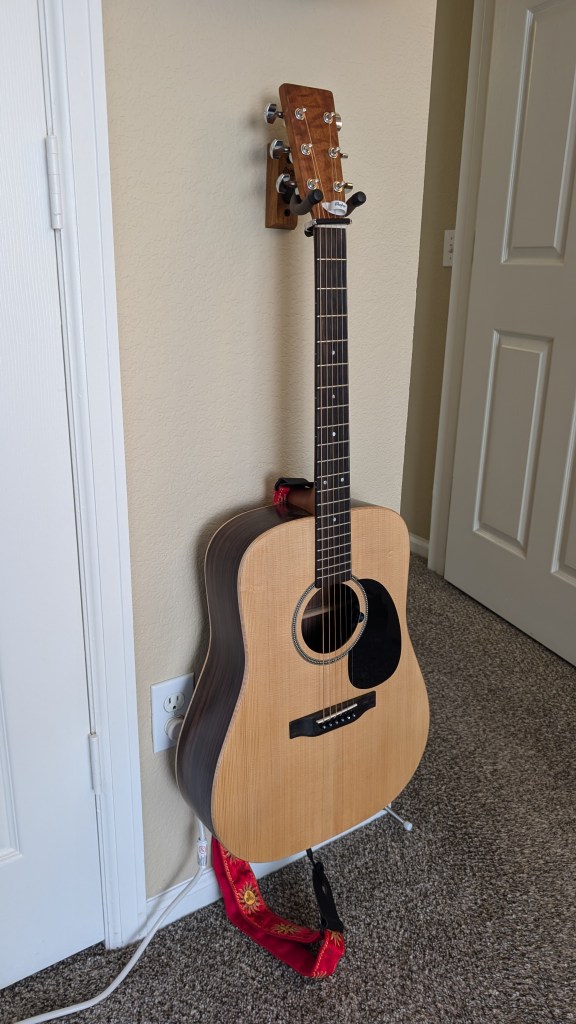
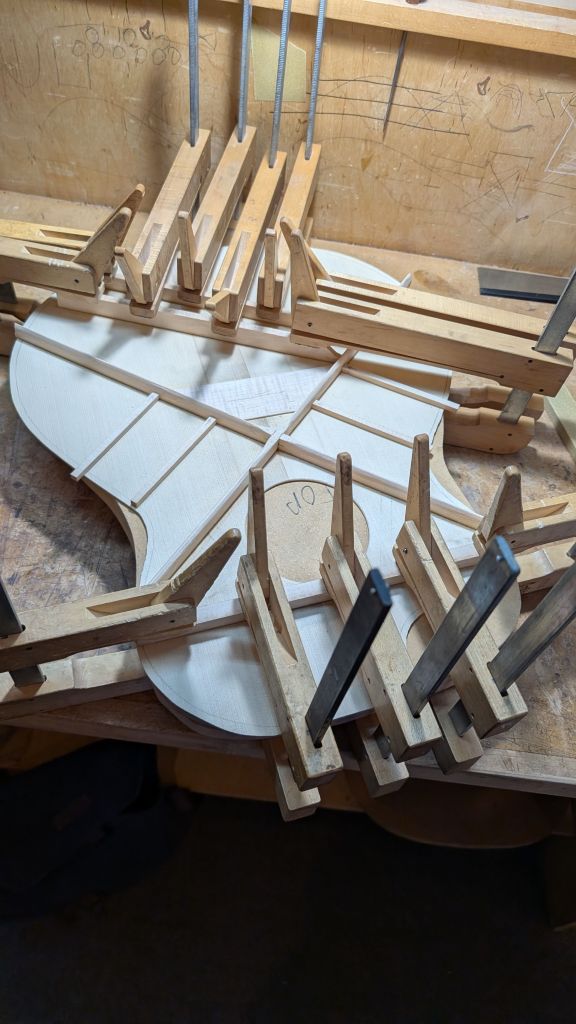
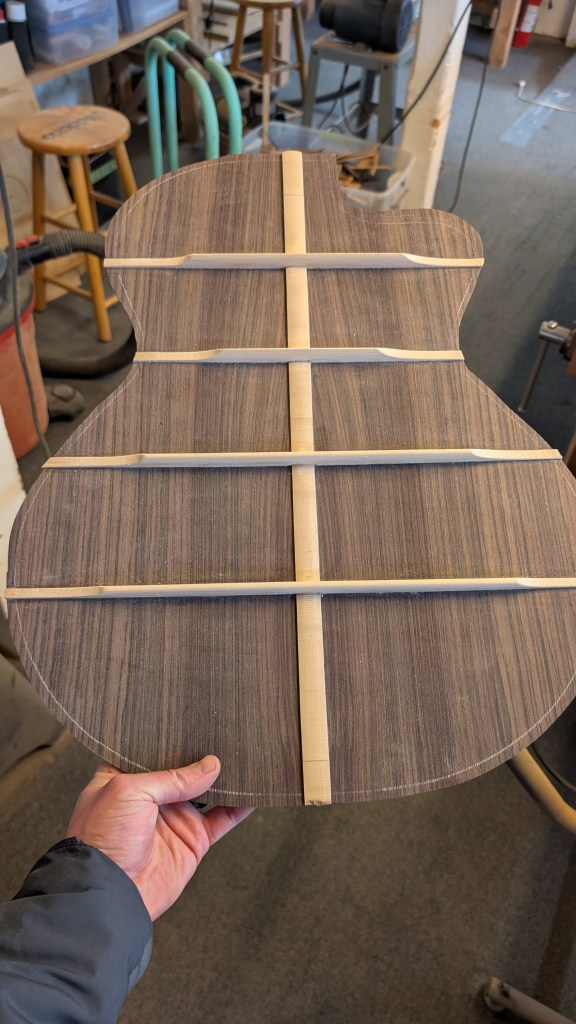
I realized I never followed up on a previous post where I talked about my progress at the Colorado School of Lutherie in making an acoustic guitar (On Tactile Endeavors Part 1). That post was a little over a year ago now. In the interim, while I do indeed still spend most of every weekday sitting before a computer prodding at a keyboard and poking at a mouse, running statistical models for my engineering day job that pays the bills, I did continue in my amateur lutherie. And much to my surprise, the guitar was finished! And actually sounds quite good! I prefer to play it over any of my other guitars these days. A pic of it can be seen below. Pre-war bracing style 1930’s Martin dreadnought with east Indian rosewood back and sides, Sitka spruce top, ebony fingerboard, mahogany neck, and flamed maple headstock plate and edging. In the process of building it, I might have been bit by the lutherie bug, as I’m building another this year. This time around it’ll be Grand Concert body shape with an Engelmann spruce top. Learning some new techniques this time around so the process is a bit slower, but well worth it. At the end of the day, I’m just enjoying learning something new while getting to watch a guitar come together beneath my own hands.
I recently watched the Hollywood adaption of Project Hail Mary starring Ryan Gosling, itself based on the book of the same name by Andy Weir. I did read the book years ago, and my fiancé read it in advance of us going to the movie. I’ve made many posts on adaptations at this point, so readers of the blog can probably anticipate some of my thoughts on this one. To put it simply, I liked it quite a bit. For those who have read the book, I found it to be a pretty faithful adaptation. My only real critique was that they had to drop so much of the science, but that was a change made understandable by the medium and the target audience. Without going into spoilers, if you enjoyed Andy Weir’s other book/adaption, The Martian, or really any tale of an intrepid space traveler using scrappy problem-solving in an attempt to save humanity, you’ll enjoy this one. Given his appearance in the trailer and general popular culture at the moment, I feel like it’s not much of a spoiler to say our astronaut meets an alien. His name is Rocky and he’s pretty great. Big thumbs down (you’ll get it when you watch the movie, it’s a good thing).
For those who have already seen it, I’m curious on your thoughts. For me, as I mentioned before, my only real critique was that so much of the science was lost. For example, there was much made of the main character Ryland Grace’s argument that water was not requisite for life. In the movie, while this was brought up in him being roped in to study the astrophage, after it was shown astorphage did indeed require water, it wasn’t mentioned again. In the book, ample time is spent on the particulars of Rocky’s fascinating biology. While Rocky still technically requires water, the high pressure of his home planet Erid and its ammonia atmosphere makes for some interesting ways Rocky’s people evolved to cope, such as liquid mercury functioning as his blood. While not a full proof of Ryland Grace’s theory, as Rocky still uses water-based cells in his body, it does directly show that life didn’t require the thin goldilocks zone temperature band so many of Ryland’s peers had assumed.
However, even though much of the science wasn’t discussed to the same depth, there was one aspect that the movie improved upon: character. Andy Weir as an author is incredibly skilled at making the scientific method of trial and error and constant learning incredibly exciting to read, weaving it into sci-fi stories of intrepid heroes doing their best against the odds. Sometimes, however, character work gets less focus. Enter the writers for the movie adaption, Ryan Gosling, and whoever voiced Rocky. They gave them a depth that was at times lacking in the book.
To summarize, each of the mediums has their strengths and weaknesses: the book expands on the science while the movie expands on the character work. Either way, it’s a fantastic tale worth enjoying.
I don’t read that many comics or graphic novels to be honest, though I do have a few on my shelves. Looking now, I can see Berserk and Blacksad, comic continuations of both Avatar: The Last Airbender and Firefly, and Anthony Bourdain’s Hungry Ghosts. I picked up a copy of I Kill Giants, written by Joe Kelly and drawn by Ken Niimura, without knowing much of anything about it. I knew there was a movie adaptation that I’d never seen, and that it tells the story of a young girl who says she hunts giants, who says she can see pixies, signs in the sky, and all manner of fantastical creatures roaming about her school. The rest I’d managed to not spoil for myself, and I’m not going to spoil more in this paragraph. This is a tale best read without knowing much about it. I will say that, for me, this story’s accolades are well deserved. If you like a tale with a heavy theme yet deftly told, give this one a look. For those who have already read it or fear no spoilers, keep reading. As Joe Kelly states in the author’s dedication before chapter 1, “To those fighting your own giants. You’re stronger than you think.”
Here Be Spoilers
I don’t think trauma is a one-size fits all type of thing. Yet, as humans, there are no doubt commonalities to how we process grief, how we cope with the death and suffering of loved ones. If that weren’t the case, therapists and the like would have a much more difficult time, each new client or patient a heretofore unseen and unfamiliar type of puzzle. Rather, while each person is no doubt a puzzle that requires expertise to unravel, I get the feeling there are favorite knots and snarls we as humans have evolved to favor. We’re not quite Rubik’s Cubes, disordered colored tiles that require only a finite number of set actions to inevitably solve, yet neither are we Goldbach’s Conjecture, a mathematical theory whose proof has eluded mathematicians for many years now. We are something between.
The death of a loved one is an unfortunate reality of life that all of us have to face at some point or another. It’s just, you hope that one does not have to face that too young, while the brain has yet to form coping mechanisms, as it were. Not that it’s easy to face as an adult. We learn towards the end of the book I Kill Giants that the main character Barbara has created this fantasy world of hers to escape the reality of her mother’s terminal illness. This story is nothing if not the tale of a young girl coming to grips with her mother’s impending death, of her learning to embrace what little time remains. It’s a well told story, one that could have easily tilted too far into the dark or too far into the saccharine. It does neither, deftly threading the needle. The art is fantastic too, doing a great service in bringing Barbara’s tale to life.
Outro
As one who spends much of their time immersed in the fantastical, I have occasionally heard critiques from those who don’t enjoy such tales, deriding them as escapist, as childish attempts to hide from the harsh realities of the world. I can’t argue that there isn’t a tinge of escapism to fiction, but I would argue that this characterization entirely misses the point. Stories are nothing if not exercises in empathy, curated by the author but wholly experienced by the reader. Whether containing fire-breathing dragons or giants the size of skyscrapers, we tell stories, we consume stories, to experience life from another perspective, to learn, and sometimes just to experience something cool. The best tales, no matter what fantastical elements they contain, are grounded in human truths. They are a guided tour, and they help us process. In this story, that was what Barbara needed in order to come to grips with her mom’s illness. May we all be able to work through our own demons with the same success.
I’ve always been a fan of Christopher Nolan films. I recently bought a blu-ray collection of his movies, including films back through Batman Begins and The Prestige (wish it had included Memento). For whatever reason, Interstellar was the last of his filmography I had yet to watch. Given my love of sci-fi and the film’s well regarded status, and my brother’s continued attempts to get me to watch it, I’m not quite sure what took me so long. Finally, after years of seeing that meme of Matthew McConaughey crying in a spaceship and not knowing the reason as to why, I gave it a watch. Just as my brother always said I would, I loved it. So, let’s get into it.
Back Cover Blurb
We’ll keep this section brief, because I have to think I’m one of the few who had yet to see this film that premiered over 10 years ago now. I’ll stick with the high level easy to glean aspects of the plot, things that could be learned through cultural osmosis let’s say, or found in a back-of-the-book style blurb, if movies had such things. The film largely follows Matthew McConaughey’s character Cooper, an ex-NASA engineer and test pilot, and his family, a daughter Murph and a son Tom (a young Timothée Chalamet I entirely forgot was in this movie). The earth has been ravaged by blight, such that dust storms are a frequent menace, and food shortages are the main risk to continued human life. Suffice to say, the earth is dying. As one character early on puts it: “The world doesn’t need any more engineers. We didn’t run out of planes and television sets. We ran out of food.” The way a hidden research facility of a now largely defunct NASA suggests to resolve this is through interstellar travel (cue title). They aim to leave earth for another habitable planet. A wormhole has opened near Saturn, allowing for travel to a new system with potential homes for humanity, all near a massive black hole. The real-world theoretical physicist Kip Thorne who advised for this film had a lot to play with here, and it shows. The gravitational time dilation part and parcel to travel near such a massive object is at play to great effect. Those who go in on the mission would be risking it all in order to save humanity. And risk it they do.
Here Be Spoilers
Sci-fi, as with most things, exists on a scale. At one end is Star Trek (which, don’t get me wrong, I love Star Trek The Next Generation, Jean Luc Picard number one!), and at the other end is films like The Martian, based on a book of the same name by Andy Weir. One plays fast and loose with science to the point of their technical sounding nonsense ramblings at times reaching the point of self-parody, and the other sticks with the known rules of the universe as best they are able. To be honest, I enjoy both, so long as they are consistent in their choice. One finds stakes and fun in outlandish scenarios that could never happen in real life, and the other finds drama in dealing with the constraints all us flesh and blood mortals must follow. Most sci-fi stories land somewhere between. This movie, while certainly taking some liberties, largely tries to stay within the bounds of what could be, theoretically anyway. The aforementioned physicist Kip Thorne even wrote a book titled “The Science of Interstellar.” Even the existence of this book should indicate where on this scale this sci-fi move lies. I was particularly struck by the incredible depictions of both the wormhole and the time horizon of the massive black hole Gargantua. They blew my mind. And since we are in the section of spoilers, let’s get to the gravitational time dilation. Its impacts in this film tore at my heart strings. After so many years of seeing that meme of Matthew McConaughey, I finally knew its context, and I’ll be damned if I didn’t cry along with him. As someone who currently has no kids but is leaving that possibility open, I can only imagine the pain of watching your children grow up without you. They had just barely escaped an ocean planet unsuitable for life and had lost a crew member in the process, only to make it back to find 23 years had passed. As usual, the soundtrack by Hans Zimmer was incredible, and its impact hit home in this scene. I wondered why people got all dewy eyed by the song that plays. Now I know. In other heart wrenching moments, I never did trust Matt Damon’s character, but I found the extent of his betrayal both surprising and inevitable. I figured Matthew McConaughey’s character had been the one to be playing with the gravity in Murph’s room, but I still teared up a bit at the reveal. By the time he escaped the black hole and talked with his daughter on her deathbed, I think I was just a touch numb.
Outro
Basically, if you were like me and waiting for just the right impetus to go watch this gem, let this be it. I give it a hearty recommend.
I finished reading The Poppy War by R.F. Kuang recently. For those who are unaware, it’s a grimdark fantasy tale that pulls a lot of its material from China’s past several hundred years or so of history, in particular the Sino-Japanese conflicts and the Opium Wars. It is dark, with the depicted events all the more disturbing for their grounding in real world happenings. Of course, it being a fantasy tale, it pulls in non-historical concepts too. There are those in this novel’s world with shamanistic magical powers that range from turning into a fox, to becoming a maniacal ape-like warrior harnessing the powers of the Monkey King. Of particular import are a race of people known as Speerlies who can summon the fire of their god, the Phoenix, when in the correct mind-state. Talking about mind-state, psychedelic drugs play a significant role for all the shamans. But, before that, let’s get back to the real world history for a bit.
First off, I’m very much a white dude. I grew up in southern Indiana, and my pale skin fears the burning heat of the sun almost as much as the midwestern American palate fears spice. I rebelled on both those fronts, resulting in many sunburn-adjacent tans and a gradual spice tolerance built from tear-inducing meals. When it comes to Chinese history however, I think my knowledge there is different than my childhood background might initially make it seem. Namely, I minored in Mandarin in my undergraduate studies and studied abroad at Shanghai Jiao Tong for a semester. In that time, I developed a fondness for that area of the world that has led to many subsequent trips over the years. As a result, while I’m certainly no expert, many of the historical events that informed this novel were familiar to me beforehand, along with some understanding of China’s dynastic and post-dynastic history. I knew of the unspeakable atrocities committed at the Rape of Nanjing by the Japanese army in 1937/38: the wanton murder and the rape of innocents, the competitions among the Japanese soldiers to see who could kill more helpless people, the sadistic torture and truly inhuman acts of violence. Just to give a further example of how bad it was, a German member of the Nazi party by the name of John Rabe is credited with saving many civilian lives through the establishment of a safe zone. I had also read of the Opium Wars in the 1800s in which Western powers extracted several rather unequal treaties over the right to trade addictive Opium into the country. On a more recent historical front, I’d also read of Mao Zedong’s so-called ‘Great Leap Forward’ that caused one of the greatest famines in human history, resulting in the death of millions.
Suffice to say, there is a lot of historically-inspired human suffering in this fantasy tale. At times, especially with respect to the Rape of Nanjing, this novel pulls its descriptions almost straight from the history books. Reading some of this was … hard, and all the more so knowing a corollary event actually happened. This book takes these real events and puts a fantastical spin on them with one question at the fore: why? This book is nothing if not an attempt to understand how a human being can rationalize such evil acts, on how one might abhor such things only to then commit similar acts themselves, whether for power or vengeance. It tells how violence, even when done in the name of justice, still begets violence. Of sunk cost fallacies and broken descents into madness even while clambering to escape. Of choice and consequence.
So, would I recommend this book? Well, it depends on your taste. If you like grimdark fantasy and have an interest in Chinese history, I would say give it a read. For me, I’ve found grimdark can be hit or miss. I don’t typically go to novels to be smacked in the face by descriptions of the evils of this world. I see enough of that already in the news. I like having people I can root for. Call it sentimental, but I like having a hero or heroine save the day. Don’t get me wrong, I want complexity and moral ambiguity, but still, I often go to novels for a coherence and meaning that the real world so often lacks. That being said, I do also think the message of this novel to be an incredibly important one. And so, I am at odds with myself. On a more technical level, I thought the writing was good but not always necessarily my cup of tea. Sentence structure at times struck me as odd. And while the fantastical depictions of real life events were incredibly powerful, the plot did feel at times beholden to history in a way I wasn’t used to for a fantasy novel. As a result, I return to my earlier comment. If you like grimdark fantasy and have an interest in Chinese history, give it a read.
There is a point where the phrase “nothing worth doing is ever easy” drives one to near masochism. It usually doesn’t. I would say on most occasions it’s a decent enough shorthand. But there is no shortage of Sisyphean tasks out there, and some are even less useful than eternal torment pushing a boulder up a hill only for it to roll back down whenever you get close to the top. Some bureaucratic formwork comes to mind. Although, as an engineer, I will die on the hill that proper documentation is important. No matter, there are countless classic examples of daily chores that fit into the traditionally Sisyphean bucket: laundry that can never be truly done because you are dirtying clothes even as you wash others, dishes because the necessity of eating creates more, and weeding a garden because nature has its own designs that will inevitably overcome mortal efforts. I’m empathetic to the absurdist takes of philosopher Albert Camus in this regard: revolt against a universe unresponsive to humanity’s desire for meaning, clarity, and order. Revolt by accepting the silence and forging forward regardless, finding your own meaning along the way. However, I am no absurdist. Personally, I’m an agnostic. I would never go so far as Camus and call the acceptance of a higher power “philosophical suicide.” When religion is done well, it offers a place for hope, comfort, and caring acceptance. Why would I ridicule others for that? Rather, my stance can be summed up by a phrase I personally think most people would do well to more readily say: “I don’t know.” I don’t know if there is a god. My experiences viewing the world and the stories of those far less fortunate makes me think it unlikely. There is so much needless pain and suffering in this world. Joy too, absolutely. But the prevalence of the former makes the existence of an all-caring, all-powerful god hard to accept for me. And so I continue on, trying to do right by myself and others and find meaning along the way. And if there is a hell, I should think there is a special place reserved for those who usurp the intrinsic human need for hope and meaning for their own gain, for those who use religion as a tool for power and manipulation. But, I digress, how does this relate to the video game Hollow Knight: Silksong created by Team Cherry? If you’ll indulge me, a fair number of ways actually.
For those unaware of this game, it is a sequel to 2017’s Hollow Knight. I played that game all the way through, eventually getting 112% completion or whatever ridiculous percentage was the max. Suffice to say I enjoyed it immensely. It, and its sequel, is a metroidvania platformer. If those words don’t mean anything to you, it’s a 2d side-scroller where you control a little guy as he jumps and fights his way through a haunted bug kingdom to uncover hidden secrets. The sequel, Silksong, picks up after the events of the first from the perspective of a character who’d only had limited scenes in the prior game. The boss fights are plentiful and difficult (just like in the first game), and you will die many times before you manage to succeed (also just like the first game). Think of old-school Super Mario World but harder and you’re getting near the right track. I reference Sisyphus, Camus, and near masochism above because, unless you are an experienced gamer, the difficulty of Team Cherry’s games will likely summon that familiar Dark-Souls-like urge to throw your controller across the room in frustration as you die to the same boss for the umpteenth time. I certainly had those moments. I also recall the triumphs when those bosses made up of pixels on a screen fell to my digital blade. Pointless? By most metrics I would say it was. Hard? Certainly. Enjoyable? Yep, aside from when the frustration burned at its hottest perhaps. But now for the all-important question. Did I find it worthwhile in the end? Indeed I did! And therein lies the paradox. I don’t have an answer mind you. I’m just some random dude on the internet. But I will say this, accomplishing something hard can be its own reward. And when you throw in a stellar soundtrack, fantastic art, and impressive game design, you have yourself the makings of a great time. In my opinion, Hollow Knight: Silksong followed in the steps of its predecessor and delivered a solid experience. If I had to get nit-picky, I would say it does have a bit more fetch quests of sorts than I would like, but that is a small quibble in the scope of things. For any interested in a challenging video game to throw themselves against, I give both Hollow Knight and Hollow Knight: Silksong a hearty recommend.
Oh yeah, I almost forgot. Why did I bring up the comments about religion above? Well, while these games take place in kingdoms of intelligent bugs, they are quite dark in theme, and they delve into religion used to manipulate the masses. I won’t spoil any of the lore here, as I think it interesting to uncover while playing the games, but suffice to say the gods of these bugs often don’t bother themselves much with the wellbeing of their followers.
I read the novella All Systems Red by Martha Wells (the first in the Murderbot Diaries series) prior to watching the Apple TV+ adaptation that simplified the title down to just ‘Murderbot’. As any who have read some of my past posts could probably tell, I find the art of adaptation really interesting. What the adapters add to or cut away from speaks volumes to their motivations, or the motivations of the execs signing the checks. Adaptations are just like anything else; their quality runs the gamut from the well cast but terribly written Dark Tower movie adaptation, to the landmark Lord of the Rings trilogy. As far as the Murderbot adaptation goes, I was uncertain at first, but it stuck the landing in the end. Let’s dig in, and I’ll do my best to avoid any spoilers.
For those unfamiliar with the premise of the Murderbot Diaries in general, it is a sci-fi series following a bio-mechanical android created to act as a security unit, or SecUnit. The first entry in the series, All Systems Red, shows us the titular SecUnit doing his best to protect the clients assigned to him as they conduct research on a hostile alien planet. The tricky part is, this SecUnit has hacked his governing module, giving him autonomy when all such units are supposed to be fully under human control. As a result, this SecUnit, who calls himself Murderbot due to the hazy memories of a previous malfunction, does his best to fulfill his role without drawing undue scrutiny. He protects the humans, but any attempts at social interaction terrify him. He much prefers to watch the space opera tv shows he has downloaded to his internal storage. It is a comedic story that examines what it means to be neurologically different than the mainstream, while also including alien fauna and sci-fi shootouts. I give it a hearty recommend.
So, back to the adaptation. How does it do? Well, at first, it felt like it was making a classic mistake in this space: dumbing down the characters. I’ve seen this time and time again when Hollywood gets its hands on a story. They feel the need to have every character make the stupidest possible decision, often against previously established motivations, in order to further the plot. More often than not, it comes off as the lazy writing that it is. However, when it comes to Murderbot, while they did dumb down some of the characters, they did it for what I felt to be a good reason in the end. This makes all the difference. To clarify a bit, the scientists Murderbot is assigned to protect are from an independent planet outside the Corporation Rim. As a result, they aren’t so keen on the indentured servitude or outright slavery that corporations regularly engage in. They feel uncomfortable around Murderbot, as they rightly view such practice as the subjugation of an intelligent being. You could label these scientists as space hippies, and you wouldn’t be far off. The thing is, in the books, they hold these views and are utterly capable at their jobs. Dr. Mensah, leader of their expedition, shows herself as decisive and calm in the face of terrible danger. The rest of the crew, while perhaps not as outwardly calm, each come through in their own capacity. In the show, however, the writers really leaned into the space hippie vibes. Which, don’t get me wrong, I love me a space hippie at times. But, having read the source material, the first couple episodes just felt a bit odd due to the change. They made them far less capable, made them ill-prepared to be thrust into a hostile alien planet. It made for some laughs, sure, but I still wasn’t sold on the shift. However, as the episodes progressed, I started to see more of why they’d done it. They wanted to give the characters more of an arc across the season. They wanted us to watch as these scientists grew in the face of difficult odds. This became particularly clear with Dr. Gurathin, the scientist who most distrusts Murderbot. Without giving away spoilers, the final episode of the season made me tear up a bit and banished any doubt I had in the adaptation. They stuck the landing, and I’m ready to watch season 2. Also, the lead actor for the series, Alexander Skarsgård, does a fantastic job in my opinion.
Over the Garden Wall is an animated limited series that originally aired on Cartoon Network way back in 2014. I first watched it years ago with my brother, but recently revisited the series after purchasing a DVD copy. These days, out of a desire to be less dependent on the whims of the streaming companies, I’ve been trying to improve my DVD and blu-ray collection. I’d rather not get stuck in a repeat of what occurred with the series Infinity Train.
Upon re-watch, Over The Garden Wall was as I remembered: a quirky, folktale-inspired story with more depth than first appears. The creator, Patrick McHale, was best known for his work on Adventure Time prior to Over The Garden Wall, and I would say the general feel of the show’s humor correlates well with the adventures of Jake the dog and Finn the human. However, instead of a d&d style fantasy world, Over the Garden Wall takes its cue more from Grimm’s Fairy Tales. While both Adventure time and Over the Garden Wall ostensibly are kid’s shows, they’re firmly in that “actually meant for adults too but animation as a medium has an unfair connotation of only being for kids so they do what they gotta do” space.
Over the Garden Wall is a weird, atmospheric tale following two half-brothers find their way out of a dangerous forest. Wirt, the older brother (voiced by Elijah Wood), is an introverted, anxious sort who writes poetry and plays clarinet, while the younger brother Greg (voiced by Collin Dean) is a more carefree sort who spends much of the series trying to settle on a name for his frog. They meet folk such as the mysterious Woodsman, the talking bluebird Beatrice, and the dangerous Beast. Odd sorts populate the forest called the Unknown, and suffice to say the meaning of the brothers’ struggle is more than meets the eye.
If the above sounds to your liking, give it a shot. The episodes are each only around 10 minutes long, and the series told its full tale in the single intended season. To make things even more fitting, watch it during the fall, when the leaves are changing and Halloween costumes are on the mind.
If its presence at the Emmys wasn’t enough to sway you to watch this show, I’m not sure what else I can say. Nonetheless, go watch this show. If you like existential, earth-based sci-fi where unsettling mysteries abound; if you have ever wondered what it would be like to split your work self into its own persona; it’s past time to give this a shot. I already did a post on Season 1, and what I said there continues in season 2. It’s some stellar TV. The ending of this season in particular was well done. I can’t wait for season 3.
So, despite the very real superhero fatigue I’ve felt since Marvel’s Avengers: Endgame sent the purple-thumb-faced Thanos into his second, more permanent, retirement (although, they’ve opened the pandora’s box known as the multiverse, so shenanigans are always at the ready to axe both stakes and consequence), I saw the new Superman movie in theaters. Turns out, I actually quite enjoyed it. I thought I might.
My first introduction to James Gunn — the writer/director of the most recent Superman movie and now the general overseer of all things DC live action — was as the writer/director of Guardians of the Galaxy, which was my favorite Marvel movie of that era. The premise of this Superman movie felt more or less to me like they asked, “What if Superman was just a good guy? Ya know, replete with the red trunks and everything? How about we keep Guy Gardner’s bowl cut too?” It felt refreshingly earnest for a change. Still a superhero movie of course, with all the usual trappings. If you generally don’t like watching people fly around with capes, you’re not going to like this one either. However, if you’ve seen anything else of James Gunn’s and enjoy his style — quippy yet earnest, crass yet caring — then I’d give this one a watch. I enjoyed David Corenswet as superman. Same goes for Rachel Brosnahan as Lois Lane, even if it’s not as meaty a role for her as Marvelous Mrs. Maisel. And Krypto the dog, while based off James Gunn’s own dog, is some impressive CG. Hats off to the animators.
As far as DC as a whole, I don’t know. Any new superhero movie, Marvel or DC or anyone else that might throw their gauntlet into the ring, has to pass extra scrutiny given the fatigue that Marvel set into my bones with their nonstop releases leading up to Endgame. As much as I love Pedro Pascal, I didn’t watch the new Fantastic Four movie, and I’m not sure if I will. But back to DC. As far as their new direction under James Gunn, I’ll say this: I’m intrigued.