M. Weald

Sci-Fi and Fantasy Author

I read the first novel of the Night Angel Trilogy on the basis of a friend’s recommendation way back in high school, only recently coming back to finish off the last two of Brent Weeks’ fantasy trilogy (though I do believe a new entry in the same world has since been published). On the whole, it was an engaging read, feeling a bit like a time capsule for the dark fantasy often published in that era, with all the associated strengths and weaknesses therein. In some superficial ways, I liken it to the romantasy genre currently taking the publishing world by storm, except with a definite tilt towards the male reader, versus romantasy’s tilt towards the female audience. So, let’s dig into Brent Weeks’ Night Angel Trilogy, without allowing in any pesky spoilers (though admittedly it gets spoiler adjacent).

First off, for those unaware, there is the trope of a male author over-sexualizing the women in their works through base description. This is sometimes referenced shorthand as ‘breasting boobily’ or ‘boobs boobing boobily’. And, well, just do a Google search and you’ll find a number of Reddit threads discussing this phenomenon in relation to Brent Weeks’ Night Angel Trilogy. The fantasy genre unfortunately has no shortage of this trope. However, in the context of this series, the descriptions in question are often from the narrative perspective of boys in their teens or early twenties, and the general intent of their usage – at least based on my read through – was to show how it’s better not to judge someone solely on their appearance, how that could easily go awry. And in terms of an accurate depiction of a teenage boy, I was in the throes of puberty once, and while I wasn’t ever really prone to describing women in such teenage-boy-poetic fashion, I definitely knew other boys that did. So is it accurate in that regard? Unfortunately for all us guys out there, yep. These books contain descriptions of breasts and ass in the vein of Bugs Bunny ogling Lola Bunny with eyes drawn larger than his head while pulling at an imaginary necktie and saying “awoogha.” Or perhaps think of a Japanese anime character seeing a well-endowed woman and getting a nosebleed. And well, as the current romantasy boom – and the bodice ripper, harlequin romance novels that have been popular since the beginning of modern publishing – have shown, sex sells, whether targeted towards the male or female gaze. Titillation is one of the most universal of all humanity’s facets. Books have historically been a safe space for sexual expression, and I’m not here to yuck anyone’s yums, so to speak. Still, it is a lot, and how you as a reader might respond to it will vary. At the end of the day, it’s about not reducing characters to just these facets, which goes into the next topic.

How an individual’s facets distinct from one’s physical attributes are given focus is important to me in any given narrative, whether of a male or female or anywhere between. On this track, the Night Angel Trilogy has a mixed record. Certainly characters like Momma K and Vi Sovari have interesting arcs, one finding success in a realm dominated by evil men through ruthless cunning, the other overcoming her trauma to think of her body as more than just a tool used to kill or seduce. There are other examples too, such as the mage Ariel. Two of the main characters, Kylar and Logan, both young men, get their own descriptions pulled straight from the minds of horny young women and have ample agency. Without getting into specifics, the costs of Kylar’s magic drive a lot of interesting tension, and one truly heartbreaking moment in particular. However, we have Elene, one of the main characters and Kylar’s love interest, whose sole purpose in this series is in service to Kylar, and her acceptance of that fact didn’t sit super well with me. And going back to Momma K and Vi (and Elene and Jarl and others), it’s worth noting that these books are perhaps overly reliant on certain types of trauma to define its characters, and women do bear the brunt of that (though not all).

These books depict a lot of violence, pain, and suffering. Heroes need evil to vanquish of course, kind of a requisite part of most any such fantasy epic. All the better if the evil destroyed is particularly depraved. The sword and sorcery fight scenes are commensurately really fun reads, and the magic system generates some quite cool moments. But the level to which sexual assault is used to show someone is evil at times made me think I was binging episodes of Law and Order: SVU. Were these types of things common in the medieval period that serves as the groundwork for so much sword and sorcery fantasy? Was misogyny a frequent occurrence too? Do these things still happen? Yes, yes, and yes. Even so, the amount of such occurrences in this trilogy is a lot. It did wear on me a bit. Once more, how you as a reader might respond to it will vary.

So, at the end of the day, would I recommend this as a read? Well, as in pretty much all cases, it depends on your taste. If you like a dark sword and sorcery fantasy with epic fight scenes, magical conflicts, and easy to read prose – and you’re willing to wade through descriptions of some of the worst aspects of humanity before the heroes win the day – then sure thing, give it a go. Otherwise, probably go for a different one. Something I didn’t really get to here either is that, while the magic system allows for some very cool moments, there is a bit of a tendency for Deus Ex Machina type resolutions that may not satisfy everyone, a not uncommon occurrence in stories that incorporate prophesy as a key narrative tool. Nonetheless, I overall quite enjoyed this series and its ending. As far as whether I’ll read the follow up series, not sure. These days, it seems like the entire world is vying for my attention – everything, everywhere, all at once – and the bar for moving up my to be read list grows ever higher. Think I might read some more Ursula K. Le Guin next. I’m also finishing up The Tainted Cup by Robert Jackson Bennett at the moment, which is a fantastic read.

All the best,

M. Weald
It’s been a busy time over here, with the many fantasy and sci-fi stories I’ve read or watched or played stacking up like cordwood near an unlit campfire. So, grab a chair and take a seat, because this fire is about to be lit, and these stories burn bright and quick. As we watch the flames dance from each and every log, I’ll be keeping my thoughts brief, just a couple sentences each. No sizable spoilers will be found here either, though there might be the occasional allusion or tidbit or statement already released in promotional flyers. Anything major has been banished away from the fire, into the cold and lonely dark.

  • LOTR: The Rings of Power Season 2 (Amazon Prime Live Action Series)
    • Thankfully, I found the second season even better than the first. The overall writing was much improved to my mind, with Sauron’s manipulations as Annatar, Lord of Gifts, particularly enthralling. If you have always wanted to see the creation of the rings of power given visual form, I’d give it a recommendation.
  • The Legend of Vox Machina Season 3 (Amazon Prime Animated Series)
    • I can’t get enough of The Legend of Vox Machina. I loved the first two seasons, and I loved the third. While I’ve never watched the original Critical Role campaign which the animated series depicts, this medium is the distillation I prefer. I find myself unable to fit in the sheer length of content Critical Role’s live action roleplaying requires, yet still thoroughly impressed by the storytelling. I’m just glad this animated series exists so I can experience it. Also, the romantic in me quite enjoyed this season’s willingness to tackle romantic relationships. If you enjoy irreverent and raunchy fantastical adventure with no small amount of heart and depth, join the group of heroes known as Vox Machina and give this show a watch.
  • Tress of the Emerald Sea (Novel by Brandon Sanderson)
    • There was something particularly refreshing about this novel. While it did have a fair number of Cosmere tie ins that tickled the brain, it still felt fairly standalone. Although, that could just be because I’ve read every Cosmere book to date and any such references intrigued rather than annoyed. In any case, this book might have been my favorite of the Year of Sanderson kickstarter stories. It is a lighthearted fairy tale romance that makes any such tropes its own. Not to mention, there are oceans of spores reliant on the interesting real world phenomena of particulates like sand acting almost as a liquid when aerated from below. For lovers of the modern fairy tale, give it a read.
  • Hades (Roguelike Action RPG by Supergiant Games)
    • Roguelike’s are a hard video game genre for me. For those unfamiliar, roguelike’s rely on a looping mechanism, as in, your character generally has to restart from the beginning upon every death, at least geographically. A Sisyphean task you might say. Your character often unlocks new abilities or story notes with each new attempt. Hades is actually about the son of Hades, Zagreus, as he tries to escape the labyrinthine Underworld. With each attempt, you get farther and learn more about Zagreus’ motivations, Hades’ past, and the intrigue amongst the Greek gods of Olympus. The gameplay is stellar, the music is stellar, and the story is, you guessed it, stellar. Above all else, the game stays entertaining even as you make your hundredth escape attempt. For those who haven’t quite found a roguelike that fits their tastes, give this one a shot. Oh, and I’m not bi, but the memes about this game being a bi-sexual awakening make sense. Most every character depicted in this game is objectively attractive.
  • A Wizard of Earthsea & The Tombs of Atuan (Novels by Ursula K Le Guin; Earthsea 1 & 2)
    • I’m grouping these together as its been a minute and their stories have blurred in my mind a bit. Nonetheless, I’m glad I’ve finally visited the islands of Earthsea, this legendary fantastical realm written by one of the best fantasy and sci-fi authors to put pen to paper. I will say, these tales definitely reflect the fads of fantasy present at the times of their writing. A Wizard of Earthsea was published in 1968, The Tombs of Atuan in 1970. A Wizard of Earthsea in particular feels it, reads more akin to an epic seafaring edda than a modern retelling. Everything is told in grand scope, but as a result we never quite close in on the main character’s, Ged’s, perspective in the same way the modern 3rd person limited perspective so often does. Truth be told, this older style of writing, grand though it may be, isn’t always my favorite, yet I nonetheless enjoyed the ride and greatly appreciate its value. I think I liked The Tombs of Atuan a bit more as it shifted away from the zoomed out style, got more close to the relevant perspective. Nonetheless, if you want to see what has inspired countless fantasy tales over the past 50 odd years, definitely give this a shot.
  • DanDaDan (Anime Adapted by Science Saru, Manga by Yukinobu Tatsu)
    • Anime so often is a hit or miss for me. It usually depends on the relative frequency of what I like to call “Oh, Japan” moments, little clips of, typically pervy, cultural dissonance that just aren’t quite my cup of tea. And yet, sometimes a show can take that to the extreme in satirical fashion and it somehow works? I don’t really understand it. But this show is a topically raunchy, irreverent tale depicting two teenagers as they handle the struggles of puberty and battle errant ghosts and aliens who have a rather unhealthy obsession with human anatomy. Weird right? And yet it works.
  • Castlevania: Nocturne (Netflix Animated Series)
    • The original Castlevania animated series on netlfix has to be in my top5 shows of all time. Its blend of fun dialogue and absolutely exhilarating fight sequences kept me entranced, while the narrative and character work gave it far more depth than I’d expected going in. Perhaps because I have my own complicated history with organized religion – I went to a private Catholic school for grades k-8 – I often find the depiction of the potential evils of the church an interesting narrative hook. As far as Castlevania: Nocturne, a sequel to the aforementioned Castlevania that follows Sypha and Trevor Belmont’s descendants in the age of the French Revolution, I found it to be a worthy successor to the original, with much the same strengths. If you liked the original Castlevania adaptation, give this one a watch.
  • Arcane Season 2 (Netflix Animated Series)
    • Talk about impressive animation. This series, animated by Fortiche Studios, is clearly a labor of love. The animation is absolutely stunning. As far as the story, it’s good, a solid addition to season 1’s narrative, even if it felt a bit rushed. That would be my only real critique on this one. I know there are spin-off series in the works, and I’m excited for those, but season two felt like it could have been multiple seasons on its own, and it had several narratives that felt a tad unresolved. Nonetheless, if you want to watch some impeccable animation and a story that, while a bit rushed, the creators clearly poured their hearts and souls into, give this a watch.
  • Firefly and Serenity (Live Action TV Series and Movie)
    • Ah Firefly. Oh how I am saddened by your untimely cancellation. To be clear, I’ve watched the TV series Firefly, and its subsequent movie Serenity, multiple times at this point. This was just a rewatch to introduce the IP to my girlfriend. For those who haven’t heard of it, the show Firefly aired on Fox years ago, circa 2002. It’s a favorite of mine, one mishandled by Fox and gifted an early cancellation as a result. It’s a fun blend of the western and sci-fi genres that follows the found-family, ragtag crew of a spaceship as they just try to stay afloat. With a compelling over-arching narrative and fun adventures of the week, there’s been none quite like it since, though several have tried.
  • Severance Season 1 (Apple TV+ Live Action Series)
    • Ok, so first thing, if any Apple TV+ executives are listening, change the name of your streaming service. It’s confusing and silly given you already have a piece of hardware called Apple TV. Granted it’s not as bad as whatever HBO Max is calling itself these days, but still. When it comes to your greenlighting of shows though, don’t change a damn thing. As someone who uses an Android phone and generally refuses to buy Apple products due to the company’s high-prices and overall holier-than-thou snootiness, I can say that the shows available on Apple TV+ are fantastic. It’s the new HBO for scripted programming, in particular in the realm of Sci-Fi. And boy oh boy, does the show Severance deliver. It’s frequently directed by none other than Ben Stiller, of all people, and geez does it show the man’s range. I knew he had a taste for impeccable cinematography given his movie The Secret Life of Walter Mitty, but Severance takes it to another level. Without spoiling anything, the basic premise is that a mysterious company has invented technology that can split an individual into both a work and non-work persona. If a thrilling tale where each new turn in the nondescript hallway reveals another mystery sounds intriguing, give this a watch.
  • Devil May Cry (Netflix Animated Series)
    • This animated series by Adi Shankar is based on the video game series of the same name. It’s pretty good, a tale of hell’s encroachment on the mortal world. It didn’t blow me away like many of the others on this list though. The animation is fine, at times a bit over-reliant on 3d models to my taste. The narrative is workable, your usual rude anti-hero throwing out one-liners while looking badass. The soundtrack is stellar though. If you like the games, I would say this is a faithful adaption and worth the watch. Otherwise, I’d probably give this one a pass.
  • Sinners (Original Movie Directed by Ryan Coogler)
    • This movie is incredible. It’s a vampire tale in which Mississippi delta blues and Irish folk music blend with special import. If you like horror movies at all and appreciate good music, do yourself a favor and watch this movie. I’ll say no more for fear of spoiling.
  • Owl House (Disney+ Animated Series)
    • There is a whole genre of animated series that are purportedly for kids but nonetheless are incredibly enjoyable for adults. Shows like Gravity Falls or Infinity Train tackle complex themes but wrap them in a kid-friendly veneer. Owl House, while leaning more towards Gravity Falls than Infinity Train, is undoubtedly still in that vein. Telling the tale of a girl who wants to be a witch who finds herself in a realm where witches are everywhere, it is a fun, lighthearted story that will nonetheless pull at your emotions. If a house with an unsettling and vaguely owl-like creature named Hooty built into its walls peaks your interest, give this a watch.
  • How To Train Your Dragon (Live Action Movie Remake)
    • Ok, I have confession. While I have ranted in the past about Hollywood’s tendency for sequels or reboots or remakes instead of original IP,https://mweald.com/2023/10/02/on-hollywood-adaptations/, I still greatly enjoyed this movie. It is essentially the animated film shot for shot, with a little bit added in here or there to fill out some of the lore. Directed by the same guy who directed the animated film, Dean DeBlois, you can tell it was shot with a love for the original material in mind. As much as it pains me to say, I enjoyed every minute. If a remake is made with this much care, I’m ok with it.

All the best,

M. Weald

P.S. The Reedsy writing class I started in January finished up a couple months back. The fantasy novel I began in the class continues to accrete words day by day, even if it’s at more of a geological pace than I was hoping for. I’ve found my writing, at least given all of the other constraints on my time, is more along the lines of a glacier pushing up earth than a tornado whipping dirt into a pile. Still, I’m hoping that analogy holds because the shaping of the earth by glaciers has certainly had a more lasting impact. The novel currently sits at ~37k words, and the goal is to finish out the rough draft before the year is out.

On most occasions (with anime/manga being the exception), I tend to read the written version of a story prior to viewing its adaptation. Not so in this case. I actually wasn’t even aware Mickey 17 – a recently released science fiction film directed by Bong Joon Ho with Robert Pattinson as its lead – started out as a novel. In this case, that novel is Mickey7 by Edward Ashton. I shouldn’t be surprised. To my mind, a fair portion of the TV shows and movies that do something unique in visual media end up being adaptations of the written word. If you’re just here for a yea or nay on this film, I’ll say this: My stack of books to read is ever growing, with a nerve-inducing tilt to it that puts the Tower of Pisa to shame, but Mickey7 might find its way onto that stack based on the strength of the movie alone.

So, the movie. In short, I really enjoyed it. It feels almost a cliche at this point to say Hollywood is risk averse, that they prefer to release cardboard cutouts of films that came before, plastering these cutouts with fresh designs, with new faces, in an attempt to obfuscate their common origin without removing their comfy familiarity. It is a business after all, and the best data that companies have for what will succeed in the future is what has succeeded in the past. Unfortunately, it is also a truth that this perhaps isn’t the most encouraging environment for creativity, that in their attempts to make new movies marketable, movie studios sometimes smooth away any of the endearing rough edges that would make these films stick out amongst the crowd. Though I haven’t watched it yet, I hear Seth Rogen’s new comedy, The Studio, on Apple TV+ does a good job of satirizing this dynamic. Of showing the unavoidable push-and-pull, the intrinsically opposed nature of running a business while wanting to create new and inspiring art. Commercialism vs. artistic expression. It is a difficult dynamic, one the book publishing industry is no less prone to. This isn’t to say I’m pessimistic on storytelling industries as a whole. Far from it. At the end of the day, we are in a period of unmatched luxury when it comes to the sheer volume of amazing stories out there, across every medium. Still, I don’t think it controversial to say that massive Hollywood budget films tend to play things too safe. As a result, it’s all the better when you get a movie like Mickey 17, something fun and fresh.

Mickey 17 has the hallmarks of a Bong Joon Ho film, blending genres of science fiction, horror, and comedy scene to scene and shot to shot. It details the story of Mickey, a hapless but well-meaning sort who, with his friend, signs on to a spacefaring adventure to colonize the icy planet Niflheim. In his urgency to escape a murderous loan shark, he signs on as an expendable. This means he’s given the riskiest of jobs, then he is cloned, or printed, with memories intact, upon each of his inevitable deaths. It’s … not a great job, to say the least. Once arriving at Niflheim, things escalate quickly. We get a Nausicaa and the Valley of the Wind like race of native creatures with whom the unscrupulous spaceship captain and earth-side politician – played by Mark Ruffalo – drives tension. Without giving away any more, it is a film much worth watching. And unfortunately, even though it’s gotten positive reviews, its box office haul has been underwhelming. I encourage you to watch it however you can, because movies like these are worth supporting. I give it 17 Robert Pattinsons flopping out of a body printer’s worth of a recommend.

All the best,

M. Weald

So often in storytelling the topic of pacing is brought up, belabored upon, critiqued. But, to my experience, it’s more often than not in one direction: readers, viewers, or listeners telling the author to put the pedal to the floor and get moving, to stop getting side-tracked by self-indulgent curiosities and keep the story going. I myself have said as much on occasion. While I greatly enjoyed the novel Wind & Truth by Brandon Sanderson, I mentioned in my previous post how I thought some bits here and there could have been cut. I adore Stephen King’s novels, but I’d be lying if I haven’t said, whenever the topic of his novel The Stand makes its way into conversation, that the middle third felt a slog I struggled to read through. I thought of that middle third like a long distance run or multi-day hike: just one step – or word – at a time. Interspersed with beautiful moments, sure, but undoubtedly requiring an effort of mental focus to barrel through. I know my writing can be divisive as well. Either readers enjoy the frequent descriptions or they find it just too much, taking away from something good through overuse. So, I suppose, as with all things, there is a subjective aspect to all this. Nonetheless, I would argue it is still a fundamental truth that storytelling is at its best when it is done with purpose, with intention. That is a concept akin to pace but ever so slightly different. Stories should stay on track, moving according to a schedule, a pace, befitting their nature. But who decides on that track? On a story’s nature? In the beginning, the author, surely. But once the story is out in the world, the reader experience’s it on their own terms, with their own expectations. There is an interplay there, one both author and reader must be aware of. A thriller is expected to keep things moving. A cozy slice of life or an introspective literary novel not so much. I’m just about to finish up a writing class, and one bit of advice that showed up throughout was something along the lines of “write the fast stuff slow and the slow stuff fast”. Fantastic advice in general I think. But sometimes, writing the slow stuff slow is exactly what is needed. And here we finally get to Frieren: Beyond Journey’s End. It is an ongoing manga with one season of an anime adaptation out to date. I haven’t read the manga, but I did recently finish watching the first season. My favorite aspect of this anime? It knows when to keep the slow stuff slow, while still moving things along. The characters shine as a result.

So Frieren: Beyond Journey’s End. It’s general premise, at least at first blush, is a familiar one to any who enjoys high fantasy. We have a troupe of 4 adventuring heroes set out to destroy the demon king who has been plaguing the land for ages: a mage, a healer, a front line warrior, and the charismatic leader. But from there, things shift. Immediately, we learn that this group of heroes succeeded; they killed the demon king. This story, it turns out, will follow not these heroes’ journey of killing the demon king, not in the usual sense, but what comes after. Beyond the journey’s end, you might say. The throughline is the elven mage Frieren, the main character for whom the story is named and one of the party of four who killed the demon king. In this world, elves don’t age. They can die of violence like any other, but the ravages of time seem not to touch them. As a result, for Frieren, this journey to kill the demon king, though it took 10 years, was naught but a blip to her many centuries long life. She has trouble connecting with humans, with shorter lived species, of recognizing the importance of a quiet moment with a friend, of a shared sunrise, of a meal at a table whose seats are full. To put it clear, she has trouble valuing the small moments, the slow moments, because for her, there are simply too many. This story is about her going on a new adventure, one in which she learns to connect with those around her along the way. While still keeping the narrative flowing, it embraces the slow moments, and it is all the better for it. I give it a cozy evening’s, doing not much else than sharing time and space with loved ones, worth of a recommendation.

All the best,

M. Weald

I’ve finally done it. I’ve read every published Brandon Sanderson Cosmere novel to date. The journey – and given the length, general number, and content of his novels, I’d say the word journey is an appropriate one – began over 10 years back in undergrad. I have other posts on the matter (https://mweald.com/2024/01/28/on-long-chills-case-dough-brandon-sanderson/), so I won’t go in depth here, but suffice to say he has been an inspiration to me for many years now. His novels, among those of a few other authors, spurred me into writing stories of my own. That being said, just like any author, he has his own strengths and weaknesses. Speaking in terms of his latest Cosmere novel, Wind and Truth, I felt in some ways it typified both where he shines, and where he doesn’t necessarily spend as much focus. No spoilers will follow; they’ve been banished to the deep, to be uncovered at your own leisure, artifacts of another world.

So, let’s do some pro-cons. First off, the sheer scope and audacity of this series. It is astounding. Brandon Sanderson is undoubtedly a master of worldbuilding, of creating coherent magic systems that permeate all facets of the culture. He plots with the obsession and alacrity of one who has truly found in them their method of expression, putting out a sheer volume of work that makes most authors seem ridden with writer’s block. At the same time, this elephantine volume, even if a feature rather than a bug, can wander a bit, and can create a complexity that grows fragile under its own weight. Wind & Truth set out to do an incredible amount, capping the first half of the planned 10 book series: The Stormlight Archive. More than that it handled so many disparate strands weaving throughout the Cosmere. For the most part, I thought it handled this task admirably. I found the final events of the novel to be surprising yet inevitable, giving me what I wanted in a way I did not expect. It gave a sense of resolution to this stage of the Cosmere-wide conflict while marking an intriguing path to the series end. All aspects of a good ending to my mind. Similar remarks for the character arcs. Kaladin, Dalinar, Szeth, Shallan, Renarin, Rlain, Adolin, Jasnah, Navani, and others; they are all represented here, and they show real growth. Brandon Sanderson does love his characters to be at varying levels of broken, and this book is nothing if not a testament to therapy. Nonetheless, this book is a hefty tome. If you feel in danger and this cudgel of a book is sitting nearby, take it in hand and knock that danger into oblivion because this book is heavy enough to be labeled a weapon. Your feelings on this length will vary. Brandon Sanderson writes long books. This is known. And even for him, this is a long book. Personally, there were some parts that I felt could have been removed, but even so, as someone who is prone to verbosity and has been told to winnow down my work and “kill my darlings”, that is, as always, the author’s choice to make. And overall, I quite enjoyed the ride. Journey before destination, even if the journey does wander a bit.

On a different note, let’s talk about the prose. I wouldn’t call sentence by sentence prose Brandon Sanderson’s strong suit insofar as it being of literary genius or clockwork complexity. In some ways his prose can be a weakness; and it is much the same as it has always been in Wind & Truth. But that also misses the point I think. His prose is digestible, readable, consumable. For stories this length and meant to be of wide appeal, that works great, fantastic even. Granted, I do think he relies on telling, rather than the preferable showing, a bit too often, in particular telling us that a character is happy or sad or angry as opposed to showing an emotional act or speech or evocative image. Same as with the length, your feelings on this telling of emotional states will vary. It’s not my favorite. But even so, at the end of the day, I blitzed through this book in the way only a Sanderlanche can enact. It was a fun ride. I give it the book’s hefty weight in lbs of a hearty recommend.

All the best,

M. Weald

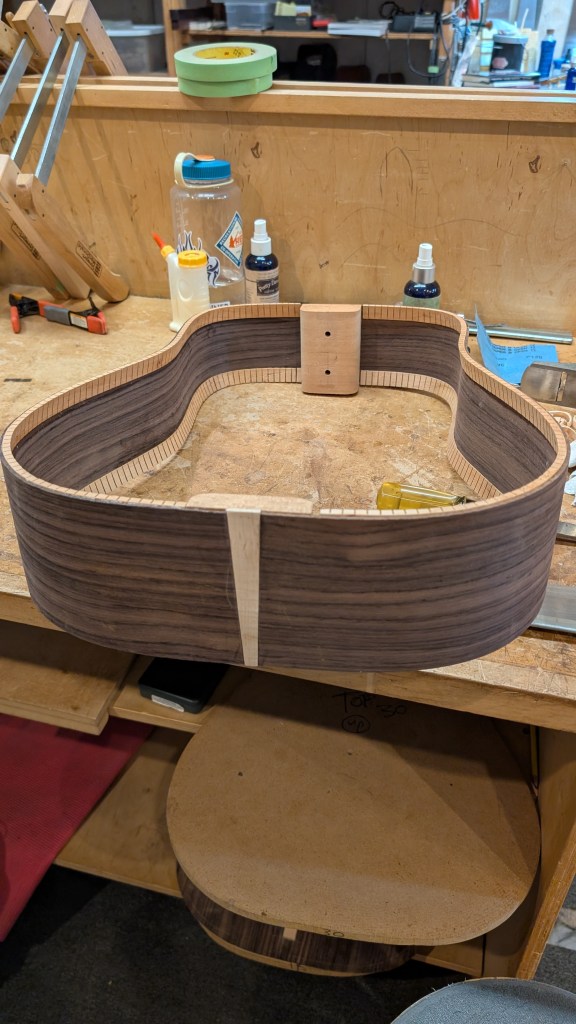
Most of my day is spent sitting before a computer, typing out words or running mathematical models, and that’s just my day job. It’s good work, and I can’t complain about not having to perform back-breaking labor that ages me prematurely day in and day out. Nonetheless, with so much time spent sitting, particularly when including my more stationary ways to pass the time like reading or writing or video games or tv or movies or … you get the gist …, I unsurprisingly find the need for movement. And not just movement of the sport kind (which I love), where movement is in the purpose of getting from point A to point B in a fun fashion while often incorporating a ball of some sort, but also movement of the creative kind. To that end, I’ve been taking a class at the local Colorado School of Lutherie to build my own acoustic guitar. It has been immensely satisfying to say the least. Seeing a guitar form from bits and bobs of wood shaped by my own amateurish hand into something that could fit in on a store rack is great stuff. Highly recommend. The shop and all its instructors are fantastic. I’ve posted a picture from this past week’s class below. Now I wonder if I could someday make a lute. Would be very appropriate to the fantasy world I’m writing for my next novel.

That’s all for today. Looking to increase my frequency of posts by including shorter ramblings. Most will still be directly about whatever science fiction or fantasy story I’ve consumed of late. But others will be like this. Taking a cue from John Scalzi’s Whatever blog I suppose.

All the best,

M. Weald

P.S. At about 20k words on my fantasy novel!

Revelation Space, the circa 2000 science fiction novel by the author Alastair Reynolds, is another book I read based on the recommendation of a friend, the same friend, in fact, who recommended Hyperion by Dan Simmons. These are two very different books, even if they are both science fiction, and they each held within different aspects that stuck with me post they’re reading. No spoilers for either going forward, so fear not words yet unseen.

For Hyperion, it felt an homage to past literary and philosophical greats wrapped in a brilliant science fiction package. The world building, or galaxy building, was great, undoubtedly. But at least for me, it was the characters and their turmoil, their secrets, their joys and pains, that made me need to read on. The interweaving of personal journeys dispensed a story at a time while the crew traveled a truly harrowing pilgrimage pulled at me, so much so by the end I found I didn’t much need to know whether the pilgrimage itself succeeded. I knew what led up to their final destination. I knew the pilgrims. That was enough.

Revelation Space felt a different experience to me, stunning in its own ways. I enjoyed the core trio of characters from whose perspectives the three strands of story intertwined – the xenoarchaeologist Dan Sylveste, the ship weapons master Illia Volyova, and the assassin Ana Khouri – but what made me feel the need to keep reading was the twisty science of it all, the traversing of the labyrinthine maze and the unwrapping of the onion to find one more secret after another. I read that Alastair Reynolds has a PhD in astronomy and worked at the European Space agency for years. That completely fits my perception of him after reading his work. He is clearly brilliant, and wielded that brilliance to create a universe-spanning mythos that felt deeply embedded in our understanding of space and time and all matters of matter. I particularly liked his willingness to keep the speed of light as the currently understood speed limit of the universe. But not just to adhere to that rule, to then make that restriction a key plot element in the intertwining of narrative threads. Without delving into spoilers, the novel opens on Dan Sylveste excavating an alien artifact on the planet of Resurgam in the Delta Pavonis system, looking to uncover evidence that the alien race known as the Amarantin were more than they appeared. This is year 2551. Another thread focuses on the assassin Ana Khouri first found on the planet of Yellowstone in the Epsilon Eridani system in the year 2524. The third focuses on Illia Volyova, a member of a triumvirate on an ancient behemoth of a space ship called the Nostalgia for Infinity, a ship whose descriptions of abandoned sections and decrepit corners lent the book a satisfyingly unsettling bent at times. This thread starts in the year 2540. These three threads and timelines join in a satisfying manner, and the restrictions of sub-light travel across the galaxy plays no small role in that.

To pull it all together, if you are interested in a sci-fi book that leans towards the hard side on the hard-soft sci-fi dichotomy with fantastic worldbuilding and a twisty plot with always another secret to uncover, I recommend a read.

All the best,

M. Weald

P.S. I’m taking a writing class and am now finished with the initial draft of chapter 1 of the fantasy novel that’s been percolating in my mind for years now! I’m aiming to have the initial rough draft ready by the end of April. This time around, I’m hoping to go the traditional publishing route, so that means, among other things, not another 250k word behemoth. I’m planning for this to sit around 80k-100k words. More to come on that later, but just to peak the interest, here is the tagline: When a priestess for human souls left adrift by forgotten gods is taken captive by the worshipers of a rising deity, she must navigate a city splintering under the schism between father and son, a city whose secrets are killing both human and spirit alike.

P.P.S. Side effect of focusing on the novel and well, you know, the job that pays the bills and everything else, means the YouTube channel is largely aspirational at this point. I hope to get back to it, so I’m not taking it down or anything, but I also don’t have any immediate plans to release more there. Regardless, the blog shall continue on! It is undead, stronger than my weak and fleshy self. I will escape whatever afterlife befalls me and come back in servitude to this blog. Forever shall it reign!

I just recently finished watching the Hulu/FX television series Shogun. For those who haven’t seen it yet, it’s an adaptation of James Clavell’s 1975 historical fiction novel of the same name. It tells the story of John Blackthorne, an English navigator who shipwrecks on the Japanese coast in the year 1600 while trying to establish maritime trade with the country, and Yoshii Toranaga, a clever feudal lord (daimyo) trying to navigate an increasingly fraught political landscape. These characters are fictional analogues to historical figures; namely John Blackthorne is a fictional William Adams and Yoshii Toranaga a fictional Tokugawa Ieyasu. I’ve never read James Clavell’s book, nor have I watched the adaptation that was made in 1980, so I came into this series without any real foreknowledge of the story or the real life events that inspired it. After watching this series, I understand why it won all the acclaim and awards that it did (something like 18 Emmys). Put simply, it’s a fantastic show. And it has two more seasons in development.

If you’re still here, all handful of you lovely readers, some other non-spoiler notes. Most of the dialogue is in Japanese, a choice I hope other shows take note of. It seems to be the case that with the rise of streaming and the subsequent accessibility of international shows, the U.S. market has gained a bit more familiarity with, and acceptance of, subtitles. It’s a welcome change to my mind; I don’t see how Shogun could have worked near so well as it did without keeping all of the Japanese. I mean, the story takes place entirely in Japan. With regards to languages beyond Japanese though, namely Portuguese, accommodations were made. John Blackthorne is a Protestant English navigator, but at this point in history it was the Portuguese, the Catholics, who had a stranglehold on Japanese trade. As a result, Portuguese was the lingua franca of the time, the trade language so to speak. Blackthorne knows Portuguese, and as such uses it to converse with the locals and the Portuguese traders and the Jesuit monks. But in the show, while they say they’re speaking Portuguese, they’re speaking English instead; because this is an American production. It works. There was a brief point of confusion in the first episode for me when Blackthorne is speaking English with his shipmates. He talks of speaking Portuguese with their Japanese captors, only to then speak English to the Jesuit monk translating his words ostensibly from Portuguese to Japanese for Yabushige, the local lord of the region where Blackthorne and crew shipwrecked. But after I realized what was going on and got that fixed in my head, there weren’t any subsequent issues. It essentially just amounts to all languages other than Japanese are relegated to English. It felt a fair balance. It still allows for all of the important character work and quirks that derive from being in a foreign country where you don’t know the language and translation is often required, without making things too unfriendly for the general American audience.

But what of other important characters beyond Blackthorne and Toranaga? There are many standouts, and an impressive female cast led by Anna Sawai as Toda Mariko. She serves Lord Toranaga and acts as translator for Blackthorne, given her being a Catholic convert who learned Portuguese from a priest. Her story is brilliantly depicted, tragic in its background and motivation. She is a complex character who does her best to adhere rigorously to feudal era Japan’s idea of honor. She often serves as the sole point of connection between Blackthorne and his surroundings, a translator not just of words but of culture, of the secret heart and self that people bury deep, of hidden ambition, of hidden sorrows, of hidden shame.

Lastly, and this is a heavy topic so feel free to stop here, this show, as my brother further highlighted to me when we talked of it, really explores feudal era Japan’s perspective on death and honor-driven suicide. It’s different than the classical European or American perspective, different from the Christian take that labels suicide a sin. I’m no expert on Japanese culture, so I can’t say for sure on the why of things, but it feels tied to the differing beliefs regarding the afterlife. Ancestor worship in Japan was/is much more prevalent, and along with that the belief that spirits of the dead are tangible and real, existing alongside the living. Whether due to that or the Buddhist beliefs in karma and rebirth, the stigma associated with death, at least for some and in certain ways, feels lessened, though no less tragic. Some characters in the show speak of choosing to die along with their lord, if only to continue in their service, to be with their lord after death. I’m not sure how prevalent that type of action was historically, but I know there are records of it being done. Other times suicide is depicted as the only way to atone for a mistake or damage to one’s honor. It’s a … disturbing take at times, and Blackthorne’s confusion and revulsion is often tangible. Honor is a very human concept; it is complicated and comes in uncountable flavors. And the traps that humanity can lay for itself, the web of responsibilities and lies and truths and expectations, are as myriad and complex as any of humanity’s most impressive technical creations, as the gearing of a watch or the design of a computer’s processing chip. Humanity has ever been good at convincing itself that choice is but an illusion, all too often for tragic or ill-conceived ends. In this show, the strings of ambition and familial bond bind most tightly of all.

All the best,

M. Weald

I read the book Hyperion by Dan Simmons based on the recommendation of a friend who described it as the Canterbury tales in space. It was an intriguing sell to be sure, and I can’t believe it took me so long to get to this incredible tale of interstellar pilgrims coming to meet a metallurgical Lord of Pain seemingly sent backwards through time. Suffice to say I enjoyed it a lot, and I’ll do my best to keep this spoiler free for those who haven’t read it.

So, where to start? John Keats I suppose. I have to admit, I’ve never been much of a reader of poetry. To be sure, I have poetry books on my shelves. But most, if not all, are of the spoken word variety. The likes of George Watsky, Rudy Francisco, Harry Baker, Phil Kaye, and Sarah Kay are the poets whose works I have. And while I enjoy reading them from time to time, I still prefer hearing them spoken, shouted, or whispered as the author intended. All that to say, I don’t know much about classical poetry. I appreciate it, surely, but it’s never quite connected for whatever reason. So, John Keats. I bring him up because his presence is felt throughout this sci-fi novel: from a city named after him on the planet of Hyperion, to the titular planet itself being a reference to the unfinished epic poem John Keats worked on till his death. But the threads go deeper; through characters and plot, Keats’ influence is there. Of course, all of that was lost on me while reading the book. That and a great deal of other literary references. My head is nearly always too busy being stuck in realms of the more fantastical variety. Didn’t catch near a thing till doing research afterwards. So I guess what I’m saying is, you don’t have to know a thing about Keats to enjoy this book. Or a thing about the fine art of poetry, or literary fiction. All I knew was that Keats was a long dead English poet of some renown, but beyond that my knowledge was as blank as the characters’ knowledge of the Lord of Pain’s, the Shrike’s, intentions.

The novel takes place in the year 2732, and the Hegemony of Man exists on planets connected by farcasters, portals that allow for instantaneous travel from place to place. Beyond the Hegemony’s influence are the Ousters, humans who live without gravity on stations floating through the blackness of space. These Ousters also live beyond the influence of the AIs, entities of the TechnoCore who aid the Hegemony. Dan Simmons, the author, does a brilliant job revealing through each of the pilgrims’ stories the intricate web of history and crossed motivations that serve to define each of these major powers, one intriguing detail at a time. I will admit that, as is common for sci-fi novels written before the turn of the century (it was published in 1989), it does take a minute to feel comfortable in Hyperion‘s universe. There is a lot of new lingo and unfamiliar technologies that have to be learned before one’s footing can feel steady, before one can leave assimilating a feel for the environment as a background task so conscious effort can focus on the threads of character and plot. One’s willingness to deal with that is subjective, but I found the process both enjoyable and rewarding in Hyperion‘s case.

As I mentioned in the beginning, this novel was compared to The Canterbury Tales by Geoffrey Chaucer when it was recommended to me, and that predominately comes down to structure. The story unfolds as it follows the seven – an auspiciously prime number – pilgrims as they progress to the Time Tombs on the planet of Hyperion in order to ask a request of the Shrike. While this main arc is occurring, each of the pilgrims tells the tale of how they came to be on their journey, their motivation for meeting a terrifying and deadly being of unknown origin as interplanetary war looms large. It is through these tales that the universe is described, through the lens of these diverse pilgrims. I won’t tell their stories here, for it would only be a pale imitation, but suffice to say each of their tales is illuminating. The final particularly so. Humans act as humans will, and if the past is any indication, the march of humanity across the stars will mostly likely contain many of the same foibles expansions of kingdoms and dynasties on this Earth have held. The book’s ending was unique. Satisfying and reflective. But perhaps most intriguingly, not at all in the way I had expected. I know there are more in the series. Undoubtedly I will read them someday. But for now, I think I’ll just reflect on Hyperion for a spell. That and try to whittle down my to be read list one book at a time of course.

All the best,

M. Weald

I’ve been working my meandering way through books I feel I should’ve read years back. ‘Salem’s Lot is one of those, especially considering how much I’ve long enjoyed Stephen King (see https://mweald.com/2024/05/31/on-fairy-tale/ for more on that). So, what to say on this well-known tale of blood-sucking vamps? First off, surprise surprise, it was a fun read. Secondly, beyond the usual strengths of any Stephen King novel set in a small, nearly forgotten town in rural Maine, I quite enjoyed King’s take on vampires, always have. Their evil is shown as ancient and outside the boundary of any modern or known religion. The usual wards and tools work, crosses and holy water and the rest, but out of an innate desire to rid the world of an evil that drew breath before any Abrahamic figure was born, not out of specific ties to a human held deity. A vampire is the raw stuff of evil, and as such can be combated by a belief in something greater distilled. That take has always resonated with my agnostic self. There is a description towards the end of the book that really brought this idea home. It takes place as one of the main characters, the writer Ben Mears, swings a hammer as a man possessed, attempting to break through to the evil vampire Barlow before time runs short. ” … the possession was not in the least Christian; the good was more elemental, less refined … It was Force; it was Power; it was whatever moved the greatest wheels of the universe.” Good stuff, that.

This wasn’t the first time I’d encountered vampires in Stephen King’s oeuvre; I believe that honor goes to The Dark Tower series. But I think of ‘Salem’s Lot as a sort of origin story for King’s take on the vampire mythos, and I believe I have some grounds for that notion. ‘Salem’s Lot was published in 75′, years before the first of The Dark Tower series was published in 82′, and even longer before we get a more complete breakdown of vampire types in The Dark Tower V: Wolves of the Calla, published in 03′. I can imagine the gears of King’s mind working over the intervening years. And of course, we see the introduction of Father Callahan in ‘Salem’s Lot, the Catholic priest whose redemption comes in The Dark Tower as a member of Roland Deschain’s second ka-tet. I wish I would have read ‘Salem’s Lot all those years ago before I read The Dark Tower. It would have made Callahan’s arc all that more impactful. Nonetheless, I’ve read it now, and for that I’m grateful.

Of course, ‘Salem’s Lot is a King book, and that can tend to indicate a couple things. King is a master at creating a sense of place so detailed it becomes a character unto itself, at creating characters both to love … and to hate (i.e. Big Jim in Under the Dome). Some of those depictions of characters to hate, or even just dislike, what with their casual comments of racism, homophobia, or misogyny all the way to actions bloody and violent and heinous, are (at least as far as the slurs) unfortunately not out of place for the setting, and at times tough to stomach. There is an argument to be made that the usage of such backwards views to engender dislike of certain characters can be a bit heavy handed in King’s earlier works, but that terrifying ability of King’s to show otherworldly depravity in the mundane and familiar is also what has kept readers coming back again and again. Some of King’s works can have inconsistent pacing – looking at you middle half of The Stand – but I didn’t see that here. If anything, I actually thought ‘Salem’s Lot could’ve been longer. The only thing that stuck out as a pet peeve of mine was the treatment of Ben’s girlfriend Susan. A bit of fridging there it felt like. Google “fridging” as a literary trope if that doesn’t sound familiar. Wish Susan could have had a bit more agency. Nonetheless, I greatly enjoyed reading ‘Salem’s Lot and think it’s cultural significance well-deserved. King’s descriptions were, as always, both interesting and unsettling in that way only he can achieve.

All the best,

M. Weald