M. Weald

Sci-Fi and Fantasy Author

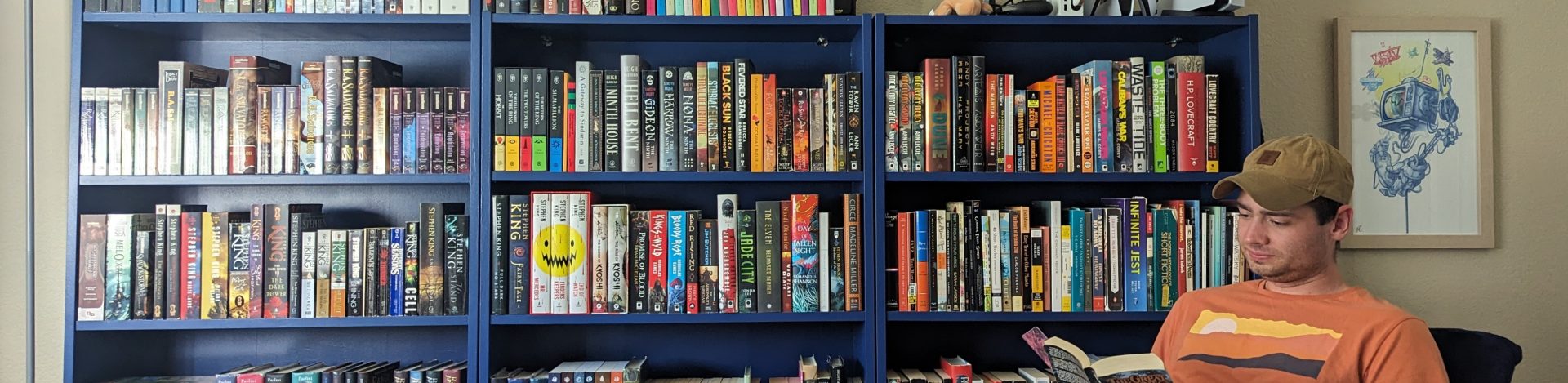
I recently finished moving halfway across the US for graduate school, beforehand coming to the conclusion all of my books needed to come along with me. As I trudged up and down the three flights of stairs between my apartment and the Uhaul with box after heavy box of books in my hands, the question of physical or digital copies was on my mind. Judging by the comments of the friends and family that helped me with the move, it was on their minds as well.

I’ll say up front I’m biased towards physical copies, as my need to drag along thirteen or so boxes packed full will attest (and my willingness to apologize each time during the move someone asked with heavy breath why I didn’t have a kindle, to which I replied, “I do”), but I’m not against digital copies by any means. They’re inherently cheaper, and the space savings are hard to beat. Whenever I go traveling I like to keep things minimalist, even more so when I’m backpacking or the like, so having the option of using a kindle is pretty much invaluable.

But there is something about holding a book in your hands and flipping the pages, feeling the smoothed grit of the paper. Not to mention I’m a sucker for cover art. I, at least in part, look at my collection of books displayed on the bookshelves as similar to prints displayed on the wall. Except books have the advantage of the stories related to their art being explicit, immersible by merely picking one up and having a read. That’s a precious thing. I’ll walk along my books and pick one up at random and read a few pages, just to revisit some of the memories. Some of these books had significant weight with how I perceive the world, whether from years past or more recent, and its always nice to revisit old friends.

At the end of the day, I purchase eBooks when the benefits of the format make it the best option, same with audio books. But if I like the book, I’ll try to buy the physical copy as well. If its financially viable, I think it’s a nice way to send money to the author, and a way to add another piece of art to my bookshelf. I recently finished The Raven by Ann Leckie on audio book and am looking forward to adding a copy on my shelves. Talking about the financial viability, that leads me to another thought.

In the future, digitization will only increase; the benefits are just too great. So, how does the practice of collecting physical objects change? With regards to science fiction, in a world where augmented or virtual reality allows for cheap and easy ways to overlay one’s world or visit another, often the cost of production is low enough that price is determined by other things: taste, stature, marketing, etc. In that scenario, physical collectors are often viewed as eccentrics, and the few tokens those of lesser means can obtain seen as valued, sentimental possessions. When talking about space travel, the increased scrutiny on every bit of mass in the cargo would drive such practices. Yet, a few precious bobbles or knick knacks or books are always taken. I think this points to what I’m getting at: there is inherent value in a tactile, physical object that no amount of technological progress can erase. Advancements might shift the balance, but the valuation is always there.

M. Weald

P.S. Perhaps foolish given that my graduate school bills loom large, but I backed the Brandon Sanderson Way of Kings kickstarter. Really looking forward to getting my hands on that leather bound copy. Also recently got a Peow cyberpunk comic from a completed kickstarter and enjoying it. I’ve thankfully had good luck with kickstarter of late.

I recently read the story Chisel and Chime by Alex Irvine, a short story in the January/February edition of Fantasy and Science Fiction, and two facets of the world stood out to me. First, every person was born with a magical spark that could be spent in a myriad of ways but also couldn’t be regained. Second, the spirits of the dead undeniably exist. I don’t mean this to devolve into an argument on the existence of spirits, but rather to ask what the world would be like if there was undeniable evidence of spirits influencing the world in such a way that dealing with their interventions became an integral part of society and culture. What would it be like if the voices of dead loved ones could interject their thoughts into our own, or even move the limbs of another? If dead spirits could be captured, if only for a time? Most would try to hold on to those who passed. Of course they would, it would be illogical not to try and reach for what will be missed. But what kind of repercussions would stem from that choice?

Often in stories the dead have been changed by their passing, bent if not twisted. Often they want to return to life at the cost of the living. No matter the case, their stay is usually temporary, the spirits eventually fading into the unknown. All stories have a barrier at some point beyond which is mystery. Permanence, if not grotesque, is usually shown as unnatural, driven by an unaccomplished goal, or unfinished business as is commonly associated with ghosts. I suppose if this wasn’t the case, the dead would crowd out the living. In Chisel and Chime, the spirit of a man who acted as a father to one of the main characters stays in a chime worn around the character’s neck. He guides the character through the wilds and teaches him to hunt and live until the spirit fades and moves on. I found that to be a beautiful sentiment, if bittersweet, where one dead too soon can stay for a time and leave in relative peace.

This also ties in to the show Upload, which recently aired on Amazon. I haven’t finished it yet, but it’s set in a future world where consciousness can be uploaded into a corporately owned digital afterlife, at least for those who can afford the nickel and dime shtick the corporations throw at them (or their families). These people who have died and been uploaded aren’t spirits in the fantasy sense, but they are consciousnesses that no longer have a physical body yet can think and interact with those still alive. The moral dilemmas here come quick and fast, not least among them the financial strain put on the living since laws state the dead can’t work (back to the fear of the dead crowding out the living), yet how can the living say no? They could save money by only spinning up ancestors for big occasions, leaving them in stasis for the rest of the time (guess I veered into Altered Carbon there with the term “spinning”). If adequate technology and resources such that simulations for all who died could be created and maintained for the foreseeable future, that would be one thing. But outside of that scenario a digital afterlife would be rationed, with Upload looking at the capitalist method and the resulting moral grey.

I haven’t really touched on the first point I mentioned about Chisel and Chime, that of everyone having a magical spark that could be spent. I will say, my first thought was that it would be an equalizer, letting everyone at birth obtain a magical spark enabling them to do incredible things. In some sense that’s true. But it’s also true that those born without much would often sell their spark for a paltry sum.

I think I’ve rambled on long enough. For any who made it this far, thanks for reading.

M. Weald

It’s been a number of weeks since I posted anything, a pause due to a number of factors that have in large part run their course. Now that much of the world and most of the US finds itself in pandemic induced isolation from closures, cancellations, and a recognition that the most at risk among us need to be protected, it felt like a good time to come back to the blog. First off, I’m an engineer, not a medical professional. I won’t be spending this whole post lecturing long-winded. I’ll say this though: trust in the medical experts, not the bellicose and arrogant who claim to know all there is to know without a shred of evidence to support their delusions of grandeur. And for those young people in my age group who aren’t taking this seriously, these measures aren’t to protect you. These measures are to protect the at-risk and immunocompromised, particularly from the asymptomatic carriers we could so easily be. But enough on that, and on to the art of figuring out how to spend an afternoon or weekend in these odd times.

For some of us, this whole pandemic has extricated us from commitments and given us all that much more time to sit in an apartment and stare out the window, or pace back and forth. If that sounds specific, that’s because I’m wearing a hole in my carpet from walking back and forth over the same stretch of fabric time and again, mind running a mile a minute, but only ever in circles, though that’s not all that uncommon. Before this, I’d often hope for time I could spend as I wish playing video games, watching shows, reading books, or most importantly at my desk writing stories. And I’ve certainly done those things. It was on the day my local climbing gym closed and it became clear outdoor trips that could overload small towns weren’t the best idea when I really started going through my backlog of games to beat (thinking of you Jedi:Fallen Order, a good game to try and live vicariously through if one is missing running around climbing on stuff) and books to read (thinking of you giant stack of to be read books at my bedside). And I’ve made some good progress on a short story. But the isolation has had an unanticipated effect as well, or at least unanticipated in the strength of the effect.

I saw a meme that had a picture of Bane from the Dark Knight trilogy with the word “introverts” written across the top and a slightly modified quote written across the bottom. I don’t remember the words verbatim, but it was a modified take on Bane’s pointing out to Batman that he had merely adopted the darkness, while Bane had been born it in, molded by it. The word darkness was replaced with isolation. That one got me. 10 outta 10. But who’d a thought I’d hit my limits within less than a week? I certainly didn’t.

For those among us who are single, its not exactly the best time to be going out on dates, so that means its way past time to realize and appreciate the connections one’s already made. Friends and family. And to take advantage of the technology to reach them since gatherings of any significant number of people are best avoided. A friend of mine gifted a copy of tabletop simulator to me, and I’m looking forward to getting that going. I have to think that game is just raking it in right now; the thing was practically made for the situation we find ourselves in. In any case, it took me way less time of not going into the office and being cut off from the usual social things to go a bit stir crazy. I’m actually using my phone to talk rather than just text. Crazy right? Who freakin knew. For anybody else out there going a bit mad with all this, if you’re looking for advice from someone whose worn a noticeable divot in his carpet in just a couple days, fire up your favorite online game and get people to join in (I’m looking at Divinity 2 right now). At least now, gaming truly is for the common good.

All the best,

M. Weald

I’m in the midst of reading a book where the protagonist has to view her own death in order to access her full suite of sorcery. A trial of sorts. In the interest of keeping this post spoiler free, I won’t name the story, but it made me wonder how I would react to knowing the details of my death. In this story, the protagonist doesn’t know the full details, not the when nor the entirety of where. She merely lives the few minutes up to her death as if time had folded inwards and for a brief spell she’d hitched a ride in the mind of her future self. Not a pleasant experience, and too disorienting to glean much aside from the stones thrown her way and the faces of those who threw them. Unsurprisingly the core responses are a deep frustration and anger. Another who had to undergo this trial saw their own death years in the future, a natural death as a content old woman. That seems almost a gift, knowing that future.

How would I respond if I saw my own death and it was a violent one? A peaceful one? In a few days, a few years, a few decades? What if it was an accidental, entirely avoidable one? It would not be a fun time learning that I die from something ridiculous like slipping in the shower.

This all leads into the question of fate, the question of whether, in this hypothetical, the prophesied future end is unavoidable. More often than not stories have the character fight their fate until they realize their struggles only pulled the strands tighter about them. It makes for a good story. Even so, from time to time, I like to see the strands of fate broken.

M. Weald

Back when I was taking creative writing classes in college, I remember a professor steeped in the world of literary fiction asking me why I needed such outlandish settings and convoluted plot in both the stories I wrote and the ones I most preferred to read. My first thought was how everything is relative. The plots I cobbled together contained twists sure, but far less than the masterful outlines of the Brandon Sandersons and Brent Weeks of the world. I thought, hoped anyway, that my writing blended the organic character building strengths of discovery writing with the cohesive, layered payoffs of outlines. What’s more, to call science fiction and fantasy settings outlandish was, in my mind, ignoring their greatest strength: their ability to explore our reality through a new and fascinating lens.

I could tell my professor meant her question in the collective sense; she was attempting to understand why some people held such an attraction to genre fiction as opposed to literary, why they felt a need for brawls, shootouts, mysterious deaths, the supernatural, the unknown horror lingering just outside the light, the mad ramblings of a prophet, or the monologues of a rogue AI. I’ll admit genre fiction can be a bit (ok, more than a bit) self-indulgent at times, but I would also argue so can any other category. I’ve read literary fiction so obsessed with appearing clever it lost any meaning it might have had. I’ve also read literary fiction that had me thinking in new and wonderful ways (this is more often the case when I happen to pick up literary fiction). Labels are created to group things with a common set of characteristics. It should come as no surprise sometimes those same characteristics will get overplayed no matter the classification.

To try and pull this all together, we use categorical labels to organize art, to create a shorthand for our brains so we can more easily find stories that fit our subjective tastes. The problem comes, I think, when we confuse subjective taste for inherent value. Stories can be such a beautiful thing, an unvarnished attempt to share and grow and empathize. Why malign one style just because it likes to throw in some magic or future tech while it explores humanity?

M. Weald

P.S.

On a different note, I’ve been trying to diversify my readership and am currently working my way through Who Fears Death by Nnedi Okorafor. Maybe I’ll write more about it later on, but so far it is pretty incredible, sobering and moving and beautifully written. Glad to hear it might be picked up by HBO. Anybody know if that’s still a thing?

P.P.S

I wrote this after marathoning episodes of The Expanse with some Farscape and a smidge of Defiance thrown in. I’ll need to write about Farscape sometime. That show is absolutely bonkers in the best of ways.

Well, I meant to attack this sooner as its now nearing midnight on the weekly Thursday blog post deadline. But something about this story seems to go well with a mad rush to finish and a headache beating at the temples like the knocking of an invasive eldritch horror. So off we go, though not until after I take some aspirin to keep the scratching thoughts of a great old one at bay.

I got this graphic novel as a gift and had no idea what to expect upon opening it. For one, the title intrigued me immediately. I’ve read the majority of the Sherlock stories and A Study in Pink is still one of my favorites. For two, the cover art is pretty fantastic. The depiction of a man clad in industrial London garb colored in a noir black and white aside from the emerald blood triggered all sorts of questions. For three, I’m a big fan of anything Neil Gaiman does, and I’ve particularly enjoyed my recent reads of his Sandman graphic novel series.

For those completely unfamiliar with the graphic novel, it’s a twist on the Sherlock story A Study in Pink that takes the detective and places him in a world of Lovecraftian horror. Honestly, I think the best way to read this story is knowing nothing more than that. The art is emotive and replete with tentacled depictions of the old ones. The coloring highlights the similar yet somehow otherworldly nature of the setting. In short, the story left me only wanting more.

Now it’s time to be off to bed, and to find a sleep bereft of nightmarish visions.

Spoilers ahead. You’ve been warned.

I just came back from the theater after watching the movie 1917, and to be honest I’m unsure where to start. My first thoughts were some of the same that crowd my head after watching any realistic war film. War is terrible, and the biggest tragedy of human nature is it seems to make war inevitable. What those two main characters went through, what the camera, unflinching, never left as they made their way to deliver a message and stop an ill-fated assault before it began. It was some incredible storytelling. The choice to make it a chained sequence of long takes appearing as one uninterrupted scene in my mind gave the film a closeness and a connection.

One of those I saw the film with wondered what Blake was thinking trying to help the downed German pilot, that they should have shot the pilot immediately. It would have both put the pilot out of his misery and have kept them from harm. I can’t argue that logic. Unquestionably it’s what should have been done. And yet … Blake chose to help. And it got him killed. A naive thing to do. He didn’t see the knife. He had reason to think the man helpless. Perhaps in that flash decision he didn’t see an enemy combatant, just someone about to burn to death in a downed aircraft. Who can say?

M. Weald

Welcome to the first blog post on the shiny new M. Weald website! Cue the imaginary sounding of a trumpet, the warbling of a synth, the plucking of a guitar, the beating of drums, the slapping of a bass or the sounds of a madman plinking away at whatever instrument you think best goes with the opening of something. Or maybe the cutting of a ribbon is better for a blog? Words don’t come packaged with sound besides whatever chords they pluck from your memory banks, so maybe think of your current favorite song? Maybe I can ride some of that excitement and goodwill just by association. Either way, I’m glad you’re here, all one or two of you (I like to think I’m an optimistic sort).

For those few of you who followed the old blog/youtube channel/facebook page from a few years back, I spent the interim getting adjusted to working full time as an engineer and writing a science fiction novel I’m in the midst of trying to get published (see novel page for details). Which is another way to say I’ve been struggling to figure out the whole work life balance thing. I’m cautiously optimistic that I’ve gotten at least a little proficient … hopefully. And now that I’ve reached that bare minimum of competence, I naturally decided I should complicate things further and start up another blog, this time under a pen name I came up with during the second edit of my novel: M. Weald.

On the old website I started out sharing a short story or spoken word poem per week, a schedule that was fun, challenging, annnnndddd only possible when I didn’t have a full time job. Damn 9 to 5! Which is really much more than 9 to 5. With way too little vacation. Anybody else think American work culture has gotten a bit out of hand? But that’s a topic for another time. Anyway, I won’t be following the short story or poem per week schedule this time around. I’ll be posting to the blog every Thursday, but the content will be much more varied, running from thoughts on things I just read or watched to thoughts on storytelling in general. And of course, sometimes just plain old thoughts. There will be the occasional poem or short story, with the stories typically in the sci-fi or fantasy realm. But those posts will take the backseat to the rest. I’ll be taking most of the short stories I write and sending them to magazines or competitions, rather than posting them here. I’m going all in on trying to get pieces of my work published, and I’m excited to see where it all goes. I not that long ago got my first rejection letter, which oddly only made things feel more legitimate. So here is to many more! (This where you and I clink imaginary glasses full of imaginary whiskey.) In any case, I’m truly excited to continue on this path and wish you all the best.

Sincerely,

M. Weald

(Wonder if I can get anyone to call me M)