A nine month streak fades, and, with any luck, a longer one begins. My apologies on missing the July post. It’s been hectic, to say the least. What with publishing my novel and preparing for a trip to New Zealand and Australia for the Women’s World Cup, things have been a bit busy. As to the first bit, the novel is fully available! I couldn’t be more pleased with the final paperback version I held in my hands prior to pressing the proverbial green button. It was published late June, so it’s been available going on two months now. In that time, it’s sold 56 copies, mostly through Amazon but around a dozen through orders at various indie bookstores. Considering my advertising to date has just been social media posts, talking with friends and family, and secretively placing QR code stickers on the backs of signposts and such as I’m walking about, I’ll take it. I’m hoping to build up some reviews from readers on the various outlets’ selling pages before going the paid advertisement route, while in the background sending copies of my novel to as many potential professional reviewers as possible. That second route may not see returns for some time, if at all. But if the process to date has taught me anything, it’s that taking pleasure in the journey is paramount, and success takes many forms. Undoubtedly the success I work for and dream of is living off what I write, but steps, each little successes of their own, must be taken. Mountains are climbed one stride at a time. Related to that, I recently got word that the Tattered Cover bookstore in Denver (on Colfax) has agreed to stock my novel in the local author section! It’s only one store, and not with the heavy hitters on the main floor, but I greatly appreciate it nonetheless. It has long been a dream to see a story of mine on a shelf, and now that dream has been, at least partially, fulfilled. One day something I write will make its way to the main floor. I’ll share a pic of where it’s stocked once I’m back in the states. And that is a nice segue way to the second point I mentioned above, that being preparing a trip to New Zealand and Australia for the Women’s World Cup.
I’m writing this in a B&B in Auckland, New Zealand, after having spent the day at the Hobbiton Movie Set. As someone who has the elvish word for friend as it appears on the Doors of Durin tattooed on my wrist, I can say it was well worth a visit. Truly a magical experience transporting to the shire, standing at the exact point where Frodo and Gandalf are first seen together in the films, and where Gandalf lit the fireworks off the back of his cart for the hobbit children. And of course Bag End. And the party tree. New Zealand is truly a breathtakingly beautiful country; it’s no wonder Peter Jackson found all he needed here. But of course, the trip wasn’t dedicated solely to all things Lord of the Rings, though that’s an entirely possible trip to make, what with the guidebook with directions to each and every shooting location readily available (I most definitely bought a copy for my partner and I’s inevitable return). Rather, the trip was multi-legged, starting in Queenstown for some skiing, a glowworm cave, and a trip to the absolutely stunning Milford Sound, among other things. That was followed up by the quarter finals of the Women’s World Cup in Auckland between Japan and Sweden. Then of course a side trip to Mordor, aka Tongariro National Park, and back to Auckland for the semi-finals match between Spain and Sweden. That second one was an absolutely incredible game to watch. And now I bid New Zealand farewell tomorrow, off to Sydney for a couple days in the hopes of snagging some tickets for the final. It’s been a fantastic vacation, and a much needed break. But of course, my brain being the oddity that it is, in the course of the trip planning, I kept coming back to a question: when it comes to video games, which do I prefer, a narrative railroad or a more choice driven open world? You might, very much understandably, wonder how that question relates to trip planning. To that I say, stay with me for a moment.
Have you ever been on a trip where you, or someone you know, planned out each and every minute of each and every day? Now how about a trip where all you booked was the flight there and perhaps some places to stay, with the rest to be figured out as you went along? Which did you prefer? I would say a video game that is more of a narrative railroad with nary a stop is akin to the first version of a trip, with the open world game more aligned with the second. As far as which I prefer, I would give the tried and true answer of one who is, according to many who know him, averse to definitive answers: it depends. It depends on the quality of the narrative, or on the quality of the itinerary to keep the metaphor going. As far as an itinerary, for me that means good food, breaks, and adventurous activities are a must. But as far as a narrative, if it is solid, as in well wrought and true to the characters involved, then sign me up for a ride. I have no qualms relinquishing control in such situations. I think Naughty Dog by and large does a great job with this on the Uncharted series and Last of Us Part 1 (I haven’t played part 2). I mean, I absolutely adore books, and what are books if not the ultimate narrative railroad? We’ll ignore the comparatively niche choose your own adventure novels for this one. But, sometimes the plot is less of the point, instead the environment, exploration, and creativity of the player more of the focus. Done well, as it is in the somewhat recently released The Legend of Zelda: Tears of the Kingdom, this can be incredibly compelling. I would argue that slapping a wooden plank to a wheel and zooming off in a random direction in the dark of the depths only to fall off an unseen cliff directly on to the head of an unsuspecting Bokoblin is hilarious and absurd and chaos at its best. This is what open world games can give, moments that shine all the brighter for their unchoreographed nature. It’s like comparing a professional dance crew to the general writhing and undulation of the masses at a club whose efforts are briefly aligned by the playing of a song they all know. Is that dance as good as the professionals? On a technical level, most likely not. But it still has a magic all its own. At the end of the day, whether a trip or a video game, I think the truth of the matter, the optimum as it were, lies, as it usually does, somewhere in between. It’s always best to leave a bit of room for a surprise.
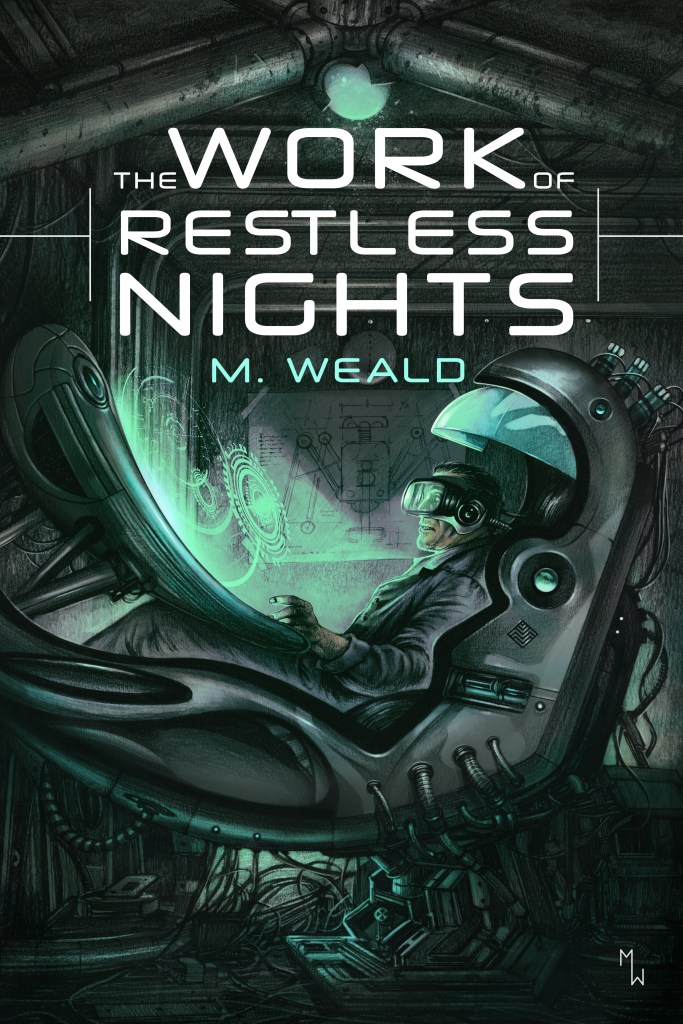
Hello there. Big news, though I think my title might have given it away. No matter, I’ll say it again, my book is finally published! Paperback and ebook. Truth be told, it has been available through Amazon for about a week now. But for all those who have an entirely understandable dislike of the corporate behemoth that is Amazon, I wanted to wait until it was available elsewhere before sharing this post. I clicked approve through the other distribution network I am using, Ingram Spark, yesterday, so it is propagating through their distribution channels as we speak, careening its way through the inter-webs and ethernet cables everywhere. Within the next week or so, it should pop up on all the other major players: Barnes & Noble, Walmart, Target, Apple Books, Google Books, Kobo, etc. It will even be available to order through independent bookstores, a route I encourage each and every one of you to take. Unfortunately, when it comes to the paperback version, the cheapest option is Amazon, because Amazon be Amazoning and they wield their market advantages with a heavy club. Truth be told, my best royalties are from Amazon, so I’m not going to say don’t buy it through them. But I still suggest supporting your local stores if you can. Bookstores are a happy place, full of the indelible smell of the written word and stories waiting to be experienced. In any case, I’m getting ahead of myself. What is the book even called, you ask? Well, look no further. It is called The Work of Restless Nights, and that right there is a link to buy it. But if that isn’t enough intrigue, keep reading.
Cover art: Alejandro Colucci
There it is! In all its glory. Have to say I was blown away by the work of the artist: Alejandro Colucci. Check out his Instagram, @alejandrocolucciart, for some impressive covers, including a few Witcher covers he did. If you’re in the market for a cover artist, can’t recommend him enough.
So, there’s the cover, but what about the internals? You know, the actual story? Fair question indeed, astute reader. Here is the blurb:
Humanity has spread its tendrils to every corner of the solar system much in the way it’s ever claimed anything left unguarded: voraciously and without compunction. A solar system wide information network known as the Grid permeates the vacuum of space, while implants permeate the bodies of humans like vines climbing through flesh. It could be said reality has three domains: the unvarnished sight of the eye unaided, the alluring veneer of augmented vision, and the immersive deep dive of a virtual world. Like a finger on a slider, people shift between.
We open in Chicago, now split into New and Old, in the nation of North America, a united continent guided in tandem by the elected human president and the Governance Artificial Intelligence. Every corporation, whether operating on a station orbiting Saturn or deep in the heart of New Chicago, is guided by its own AI: an advisor, confidant, guide, and counselor all in one. Like any technological advancement that makes lives easier, these bots, as they are called, have seeped into every aspect of society quicker than the risks could be understood.
Bots are meant to be chained to the moral code, the first tenet of which is no bot can harm a human. But the Watcher who holds the chains is itself a bot, a fragment of the Governance AI.
This story begins with a woman in a grey mask.
She stands on the edge of the road …
Intrigued? I hope so! But if that’s not enough, here’s more.
Prologue
The woman in the grey mask stood on the edge of the road, watching the trickle of traffic and people meander past. Her mask elicited a few glances but nothing more. Privacy in this modern era was hard to come by and keeping it in your own way did little to arouse suspicion.
She pressed a button on a waist high post at her side and moved onto the crosswalk. In terms of not being struck by a passing car, pressing the button was unnecessary. The self-driving cars could avoid her with ease. They monitored many meters ahead and the night was clear, roads dry. But rules were rules. She didn’t want to draw attention.
She paused when she made it to the other side of the street. A car flicked past behind her, the man in the driver’s seat fast asleep.
Before the woman stood a tall and narrow brick building in a forest of dilapidated structures, all in the impractical style common to Old Chicago. Too many uneven surfaces, rounded edges, and gaudy pieces of stonework. Altogether impractical. The retrofitted rooftop gardens looked like little green hats meant to hide a fading hairline. It spoke of a time before humanity spread throughout the solar system like a rich man at an auction with no one to bid against.
The woman sighed. She appreciated progress, one only had to look at her fine black jacket with its flexible solar cell inlays to know that. But somewhere along the line things had gotten a bit … muddled. She fiddled with the chip in her pocket, twisting it around and around.
The woman stepped into the building before her, the doors sliding shut behind. A static-filled voice over the intercom welcomed her to the establishment in cheery tones. She walked to the center of the rectangular room and tapped on a flexible screen embedded in the arm of her jacket, ignoring the voice on the intercom. It was nothing more than basic artificial intelligence, ready to answer asinine questions about the business’s services with pre-programmed responses. These companies spent their AI money elsewhere. She brought her hand to her head, resituating her mask. She didn’t know why she continued to wear earrings beneath it.
The room she stood in had been renovated over the years, taken from what must have been crumbled bits into a comforting series of hard lines and smooth surfaces. Her lips tweaked into a slanted smile, though no one could see it.
An interactive augmented reality screen came into view on the wall to the woman’s left and she walked up to it, scrolling through the service listings with a few quick gestures.
If there had been someone else in the room, sitting on the hard-plastic chairs bolted to the floor along one wall, the woman was not too sure what they would have thought of her. Just another jilted lover seeking solace in make believe perhaps. But there wasn’t anyone else in the stuffy room hidden amongst a forest of similarly stuffy rooms. It was modern, but unkempt and societally speaking in the gutter. And there were many more like it. Her amber eyes hidden beneath twin black eye plates scanned the screen showing the fantasies this tall house could make real. All the tall tales.
The woman in the grey mask tapped one finger against the screen, sliding past pictures of Ken doll bots before pausing on a picture of the business’s top seller, a newly released female recreation bot staring over her painted shoulder as seductively as something born and bred in the uncanny valley could. It did its best considering the mechanical constraints the human designers placed on it. The woman had long since accepted humanity’s irrepressible tendency to craft things in their own image. She thought of it as a weakness, an excuse for humans to say they understood what they had made. As if anything that had a face with two eyes and two lips could be understood. As if having an ankle would allow a chain to be wrapped around it.
She sighed, shook her head. She’d best get about her business for the night. After all, she meant to shake humanity out of its stupor.
After the woman typed a few commands into the screen on the wall, a ping sounded confirming her payment and falsified identification information had been accepted. A sliding panel door to the woman’s right coasted along a hidden track to reveal a dimly lit hallway lined with thin metal doors and pale LED lights. A rush of warm air, heavily scented with aromatic orange peel to cover up the mold and oil, billowed into the main room. Luckily for the woman in the grey mask, she couldn’t smell it. She moved into the hallway and walked with even steps from door to door as her mask filtered the foul-smelling particulates.
The door she was looking for sat near the end of the hallway. A lattice of thin gouges marred its surface like the scratches found in a bathroom stall, the scattered thoughts of those who’d lived in a fantasy for a few loci an hour. One disgruntled customer had written “RATHER DREAM” in all caps. Another had written the Mandarin characters for public bus, because all who paid the fee got a ride. What a childish joke.
The woman shook her head and tapped out a few commands on the screen at the edge of the closed door. The door drifted to the side and the heady scent of orange and oil and mold and caustic cleaning agent filtered into her mask. More LED lights flicked to life and the woman stepped inside, the door whispering shut behind her.
The room held shabby furniture and equally shabby décor: pocked Formica countertops made to look like wood with a small kitchen behind, a few discolored and scratched chairs, some wooden knee-high stands, a tilted bookcase, fading wallpaper, a couch with stained cushions, and a bed.
As her eyes adjusted to the dim light, a lump on the far side of the bed took on a more human shape. The ridge in the blanket started at the feet, twin bumps climbing in a gentle slope, hooking at a knee and climbing rapidly again to the apex of a waist only to fall, then rise to a shoulder. The blankets shifted smooth and slow, and the woman in the grey mask saw a tangled mass of raven hair hiding a thin painted neck. With the dim lighting, bunched covers, and wig of raven hair, the illusion looked almost perfect. With the addition of augmented reality to hide the blemishes, it would be.
The woman could have set the experience any number of ways, had the female bot clothed in any number of knock-off dresses or stringy pieces of lingerie. She could have had her stand anywhere in the room in any position, decide the scenario, code the mannerisms, the knowledge, the back story, her level of confidence, bashfulness, amenability. Anything. Even the décor could be remade through augmented vision.
Instead, she had chosen one of the stock options, the top seller. The bot in the bed was her wife, come home after both had been away at work and taking a short nap, still fully clothed in tight skirt and flowing blouse, all died deep metallic earth tones. Not new clothes, just the right amount of wear, like a well-worn shoe, like their relationship. And all she had to do was sit on the edge of the bed, give her wife’s shoulder a light tap, and talk. The bot would be the consummate conversationalist, frank when needed and understanding all the rest, coded exactly to her personality. She would make the day better, tenable, and know all her quirks and desires without any need to ask. She’d suggest the woman in the grey mask join her in bed.
The woman in the grey mask listened to the tide of the bot’s breath, in and out. Almost real, almost couldn’t hear the fans whirring in the background, the machine carrying out its designed purpose.
It was all so manufactured. So … brittle.
The woman in the grey mask hesitated. Her hand shook.
On the back of the bot’s neck, nestled at the bottom of its shock of raven hair, lay the machine interface where humans normally lodged their tech core. Instead, the bot’s control panel lay covered by a skin-toned plate. The woman in the grey mask swooped to the bot’s side and, before the bot could wake from its slumber, before her fake wife could murmur a greeting, the woman had taken the chip out of her pocket and laid it overtop the control panel. The bot’s body went rigid, its limbs locked into stasis. The woman in the grey mask lifted the thin panel out of the way and slid a thumb sized adapter into a now open slot.
“Time to see if there are ghosts in machines after all,” said the woman.
She turned around and walked out the way she had come.
And so we come to a crossroads. To read or not to read? That is indeed the question. Well you know my answer I’m sure, but that is up to you. If it helps, here is the link again: The Work of Restless Nights. No matter your choice, you made it this far, and for that I am incredibly grateful. Next month will be back to regular programming so to speak, with some other updates on marketing my novel along the way. I have some plans in that space I’m excited to share. Though I’ll admit the whole process is a bit daunting. Cutting through the noise of today’s world and getting anyone to care is no small feat. To that end, I ask of you to spread the word, to tell your friends and family. This whole operation, beyond help my own friends and family are willing to give, is just little old me. And no matter how unlikely it may be, if I’m ever to quit my engineering job to write full time, it will be because of people like you.
All the best,
M. Weald
P.S. I just saw the new Indiana Jones film with my partner, and I’ll give it a thumbs up. It’s a fun romp. Nothing particularly new, but a good time nonetheless with Phoebe Waller-Bridge a standout. It certainly stuck the landing better than the Kingdom of the Crystal Skull. And I do love me some maths. You’ll know what I mean. Might make a post about it. Who knows. Aiming to up the frequency of posting from here out.
I’m almost embarrassed to admit that I hadn’t read the seminal sci-fi novel Dune until recently. I’ve been told Dune is to sci-fi what Lord of the Rings is to fantasy. Given Dune‘s impact, it’s not an unfair comparison. Having written a sci-fi novel myself due to be published here in just a few weeks, it felt almost sacrilegious to not have read Dune prior to my novel’s release, not to even mention its writing. Late or not, I got there eventually, and I’m glad I did.
Oh, I do have one other thing to admit. I watched the Dune movie by Denis Villeneuve prior to reading the book as well. Broke all the rules on this one. Fantastic movie though. It only heightened my desire to read the book. I’m beyond stoked for the second movie. “May thy knife chip and shatter.” I had chills when I heard that in the newest trailer. I’ll watch anything Denis directs, no questions asked, but that’s a topic for a different post.
Now then, on to Dune, which was a great read as expected! If you haven’t read it before, stop here and remedy that. There be spoilers ahead. Don’t make my mistake of waiting so long. If you have, I wonder if you’ll feel the same way as I did about some of the pacing, or more specifically the time skips. The first book of the triad known and packaged collectively as Dune, itself called Dune (confusing I know), focuses on the House of Atreides and their arrival on Arrakis, the desert planet home to the makers and doomed to be the downfall of Paul’s father. We see the manipulation of the Great Houses of the Landsraad by the Padishah Emperor through his collusion with House Harkonnen, the trap waiting to be sprung by the Baron on House Atreides. We see the preparations and motivations of the mysterious Bene Gesserit order culminating in the Kwisatz Haderach, in Paul. We see the power of manipulation and foresight in seeding prophecy. I felt the first book to set up the world and stakes well, setting the stage for Paul’s journey, but I found the following two, while compelling and satisfying in their ultimate conclusion, also incomplete in an odd way. Book two, Muad’Dib, sees Paul come to this new title as he and his Bene Gesserit mother Jessica are accepted into Fremen society. Paul, trained in the weirding way, becomes the prophecy foretold while Jessica becomes a Reverend Mother by drinking the water of life, altering the poison from a drowned maker into a mind-altering, connective drug. I thought this well done, but somehow overly fast, including Paul’s connection with his love interest Chani, perhaps too dependent on prophecy to replace connection. But then again, prophecy is what this book is all about, whether false in its origin or not. Nevertheless, I wanted more related to the machinations of House Harkonnen, beyond the few scenes of the Baron handing Arrakis to his nephew the Beast Rabban, and his grooming of Feyd-Rautha. We see more significant jumps in the third book, The Prophet, where Paul, now older, fully embraces his leadership of the Fremen without the usual defeat and death of those currently in charge. We see the potential of Arrakis as another Selusa Secundus fulfilled, a warrior culture beyond the Sardaukar come to defeat the Padishah Emperor. However, it seems like there isn’t much told between the two. We see Paul atop the Fremen, Stilgar at his side. We see him learn of the Emperor’s arrival, then almost immediately him on the cusp of victory assaulting the Emperor’s ship and subjugating the powerful Spacing Guild through his control of spice. We see the death of the Baron at the hands of Paul’s intriguing, yet perhaps under-explored, sister. At this point, we know that while Paul has incredible foresight through visions of possible futures, so much so he has trouble discerning true memories from visions of futures past, we also know much is not certain, and there are many different paths leading to the great conquest in Paul’s name he spends his life trying to avoid. I would have liked to see more of that path, of the trials and tribulations that led Paul to his success over the Emperor and defeat of Feyd-Rautha in a duel to the death, of the path that led to an Atreides on the throne. Though if my critique of Dune is merely I wanted more, perhaps that is of limited use as a critique.
I’m realizing there is, perhaps unsurprisingly, so much more to say about this book, so suffice to say this won’t be the only blog post on Dune. I’d like to dedicate one to Dune‘s influence, and how modern sci-fi and fantasy stand on the shoulders of giants to improve. Until then, I want to also mention I was impressed by the author Frank Herbert’s use of third person omniscient. I felt he did a good job deftly switching from the viewpoints of various characters often paragraph by paragraph, or even sentence by sentence. I was afraid it might be jarring, but I didn’t find it to be.
Well, that seems enough for this one; Dune was truly a great read! Until next time.
All the best,
M. Weald
P.S. I get the feeling reading the subsequent books might fill some of the aforementioned gaps, but I’ve also heard they jump off the rails a bit. Either way, I think I’m going to give them a shot.
I’ll do my best to keep this one spoiler free, as experiencing a playthrough of the 2019 sci-fi video game Outer Wilds and its DLC Echoes of the Eye without foreknowledge is a joy I wouldn’t want to deprive anyone of. But I know some are particularly concerned about such things. If so, all I can I say is go play the game! It’s stellar, and all its accolades well earned. If you’re willing to risk it, I’ll try to keep any spoiler adjacent specifics limited to that which is shared in the trailers and descriptions on the publisher’s website here: Outer Wilds, and here: Outer Wilds – Echoes of the Eye. Without further ado, here we go.
Certain stories stick with you, enough so that a small, seemingly innocuous stimuli can transport you back to its telling. That stimuli can be any number of things: a turn of phrase, a silhouette, a smell, or a sensation. For those stories with a soundtrack, it can be as simple as the strumming of a few chords. Truth be told, whenever I hear the first few notes of Howard Shore’s incredible music for the Shire, all I can say is “I think I’m quite ready for another adventure.” And by that, I mean another rewatch of the LOTR trilogy (extended edition of course), or a reread of the books. The Outer Wilds soundtrack has a similar, albeit unique, effect. All it takes is a few specific notes strung together on a banjo and I’m transported back to the impeccably designed solar system trapped in a time loop, a new member of the Outer Wilds Ventures space program set to unravel the solar system’s mysteries. The only tragedy here is that I can’t ever play it again for the first time. I can reread the LOTR books and achieve the same level of joy in the process as the first time. Same with the movies. A different flavor of joy, certainly, but just as impactful, nonetheless. I’m not sure if I can say the same for Outer Wilds. I don’t think a replay, unless perhaps after many years, could recapture that magic of uncovering the ancient Nomai’s purpose and untimely demise, or the many mysteries hidden in each of the planets’ unique biomes. I don’t say that as a critique, instead if for nothing else as a paradoxically grateful lament, for it is a side effect of the game’s distinctive, and incredible, storytelling and structure. With each restart of the loop, the solar system in flux around you, you uncover a new piece of the puzzle. But this is a journey without rails, an open world exploration that employs none of the usual barring of sections behind the acquisition of a new piece of equipment or skill. An old detective’s board of clues with a spider web of yarn connecting the myriad ancient ruins awaits, and you can tug on whichever string holds your interest at your leisure. Or you can strike out at random and be sure there is something to be uncovered. After all the clues have been found, the mysteries solved, it’s up to you to bring about a resolution, one both strikingly bittersweet and philosophical. Suffice to say, I had to sit there for some time letting the entire credits roll pondering what I’d just seen.
Beyond all of the more abstract points listed out above, it’s also worth getting down to the nitty gritty of the game design, and here is where the game once more absolutely shines. The planets of the solar system are small enough to where the curvature is immediately noticeable, and yet dense enough to still feel the wonder of exploration. It is the perfect mix, exciting without being overwhelming. A similar statement could be made about the solar system itself, somehow both big and small, designed exactly as intended. The controls of the spaceship used to hop from planet to planet are impressive and intuitive. I found myself zipping around planets making up my own obstacle courses just for the joy of it. When exiting the spacecraft, you have a jetpack, and I can only say I ran out of fuel many times due to my predilection for unnecessarily jetpack-enhanced jumps, just to have the fun of feeling the effects of each planet’s gravity. It’s a remarkably designed system within which I can’t really find a flaw.
Here is where I transition to the DLC, Echoes of the Eye. I chose here because the DLC takes you somewhere in the solar system and yet not, miscible and yet distinct, a change expressed by the shift in controls. Without spoiling the how or the why, let’s just say the spaceship and to a certain extent the jetpack become less important, and even with how much I adored those mechanics the game felt in no way lacking. It was a conscious choice to create a new form of exploration and discovery, for an all-new mystery that folds nicely into the previously established lore. I will say the tonality of the DLC is different, suffused with a tinge of horror, and the change in controls only add to the effect. To put it simply, it just works.
In summary, this game is a stellar piece of storytelling, and its solar system well worth a visit. If you’re like me, the only regret after playing will be that you can only experience it for the first time once.
All the best,
M. Weald
P.S. The publishing of my sci-fi novel is getting closer and closer! It is fully edited, and I’ve decided to record an audiobook version. Best estimate is the Ebook and paperback will be released early to mid-June, with the audiobook to follow once complete.
P.P.S. The game designers used spherical coordinates for their physics simulator because they try hard and love math. Just another small detail that makes this game impossibly realistic and adds to the beauty of it all. – CO
Imagine a typical Star Wars movie or TV show. It probably has both a Jedi and a Sith in it, one or both members of the Skywalker family. Or perhaps these days it contains a reserved yet eminently capable bounty hunter with a heart of gold and a young, green Yoda-like creature in their care. But let’s not focus too much on The Mandalorian yet (quite enjoyed the first two seasons, haven’t watched the third). Instead, let’s think of the mainline movies, and in particular that not so stellar trilogy put out most recently.
The recent trilogy’s flaws were many, but I think the most egregious of them began with the first of the three, Episode VII: The Force Awakens. Its biggest failure was its unabashed copy paste of Episode IV: A New Hope, the 70’s movie that started it all, and how that choice plagued the rest of the trilogy. I recall walking out of the theater with my family after first seeing The Force Awakens back in 2015, my Dad wondering why they would put out the same movie yet again with updated graphics. It seems to me the idea behind this was to reintroduce Star Wars to a new, younger audience with a supposedly tried and true story made shiny by a modern veneer. But while the original film’s adherence to the hero’s journey in the context of an innovative space opera was good at the time, it isn’t the 70’s anymore. Joseph Campbell’s book, The Hero’s Journey, came out in 1990 and its techniques old hat now in most any context. So the powers that be at Disney tried to pivot from J. J. Abram’s direction in episode 7 to Rian Johnson’s in episode 8 where Ren was a nobody (by parentage at least, I did actually appreciate the attempt to shift away from Star Wars’ over dependence on bloodlines as a story tool), and then back to J. J. Abram’s direction in episode 9 where Ren was a Skywalker again. To put it plainly, the initial attempt to rehash the old went poorly, and the pivot was too little, too late. And herein lies the issue: the tendency to play it safe, to rest on past laurels and succumb to lazy writing. This coupled with a misunderstanding of what draws fans to the Star Wars universe. This is where Andor, and to an extent The Mandalorian before it, bucked the trend. They gave us something different in the context of Star Wars, yet familiar in the context of storytelling at large. The Mandalorian drew inspiration from spaghetti westerns and samurai films to give an adventure of the week type format, though I’ll admit the show progressively shifted to incorporating more and more storylines to setup the Star Wars TV universe at large. Disney needs its money after all. Andor gave us a heist and its fallout, a tightly written political spy thriller with a mature tone. A, gasp, limited series.
So, on to Andor‘s strengths and how to keep an IP fresh. I enjoy a long running, complex story with many characters and places interwoven throughout as much as anyone. However, I’ve come to appreciate how a limited series can lend a conciseness and coherence to a story, something Star Wars stories too often lack. I at first wondered if Andor would struggle with its ending in a sense already known, with its characters marching steadily towards the events of Rogue One. It didn’t. It gave them boundaries. It gave them a known end prior to which they could play. It allowed them to tell a more narrow story, and plumb the depths as a result. It’s a lesson Hollywood needs to learn at large. From Cassian Andor’s backstory as a child taken from Kenari, a planet ravaged by the Empire and an ill-fated mining project, to a cynical thief, to a dedicated revolutionary, we come along for the progression step by step. We see his loss, the overwhelming oppression by the Empire and the morally grey manipulation of him by the rebellion. We see human complexity, not the unrealistic simplification of light and dark. We see a compelling story willing to take a risk set in the Star Wars universe. Is it really so surprising it should succeed? It is the Star Wars universe after all, not the hero’s journey itself, that drew me in in the first place.
All the best,
M. Weald
P.S. Particular props to Diego Luna as Cassian Andor, Stellan Skarsgard as Luthen Rael, and Genevieve O’Reilly as Mon Mothma. They all absolutely crushed it. Also to all the writers on Andor, big fan. Compare Luthen’s use of warp jump to evade the Empire to any other usage of the deus ex machina that is warp jump in the Star Wars universe and you’ll see how much better they are at creating tension. Excited to see the second and final season bridge the gap to Rogue One.
P.P.S. My novel’s fully edited and formatted! All I have left is the book cover, and I couldn’t be more excited to start working with the artist I’ve hired. I’m looking forward to sharing the final results here in a couple months. More details to come.
I was told by a friend who’s already passed the somehow both meaningful and yet meaningless benchmark that is 30 years since entering this world naked and screaming that both my muscle strength and bone density would halve at midnight. I don’t believe that happened, but then again perhaps one’s mental faculties also drop in half and as such I can no longer discern the accuracy of that statement. Jokes aside, as anyone would realistically expect I feel much the same, and given the alternative to having a birthday is death, I’ll take what comes for as long as I possibly can. As Hob Gadling in Neil Gaiman’s Sandman series says upon Dream’s asking if he still wishes to live after spending the past 80 years of his immortal life utterly destitute, “Death is a mug’s game. I got so much to live for.”
Now on to something completely different, namely that of the missteps of the executives of Wizards of the Coast who, as is becoming increasingly apparent, aren’t much in the way of gamers themselves. There are countless breakdowns on YouTube and various blogs by those much more informed than I of the leaked OGL 1.1 license, so I won’t wear out a well-worn path even further. Suffice to say for those who are unaware, Wizards of the Coast, a subsidiary of Hasbro, is the company that owns Dungeons & Dragons, the ubiquitous tabletop role-playing game whose popularity has been surging over the past few years, in no small part due to the pandemic. OGL stands for open gaming license, and OGL 1.0a was the license under which a thriving tabletop RPG ecosystem was fostered. Similar in spirt to the creative commons license, it let the community use the D&D framework to make and publish their own creations. Let’s just say Hasbro and in turn Wizards of the Coast has seen all that has been created and instead of being a responsible steward, decided it was time to take what they claim is theirs. It’s been a saga of rollbacks and questionable PR statements since. As someone who has been playing tabletop RPGs for almost 15 years now, typically D&D, and is currently the DM for a D&D campaign, I might have to dip back into the world of Pathfinder. Paizo, the company behind Pathfinder, seems a much more trustworthy sort, and their announcements surrounding a new, irrevocable, gaming license are very welcome news.
On to the next topic, that being Witcher: Blood Origin. I’m not typically one to say anything negative, but it’s … not good. It had so much potential to explore an oft referenced but previously unexplored historical event in the novels: the conjunction of the spheres with the coming of humans and monsters to the world. As a fan of the novels, I’ve been concerned with much of the recent press surrounding the live action Netflix adaptions (see last November’s post) and the rumors surrounding some of the writers’ distaste for the source material, so I came in with low expectations anyway. It’s not that I don’t believe an adaptation can’t stand on it’s own as a unique piece of art, distinct from its source material, but rather that adaptions at the very least need to understand why the original worked. In the end, it would seem I should have set my expectations lower still. While the set design and action choreography are fun at times, the talents of the cast are wasted on an unfeeling script and utterly nonsensical world building (see end of first episode). There were multiple scenes that just felt … off. Scenes that should have been good, yet lacked any meaningful motivation or buildup. One major miss that only highlights how far off the rails things went is that the ancient elven culture is distinctly … normal … and boring. It is a human medieval society like so many others in fantasy. They just slapped long ears on humans and thought, meh, good enough. To be honest, I haven’t managed to get myself to watch the last episode, and I’m not sure if I ever will.
Let’s end on a high note. I’ve started my read through of Rhythm of War, the fourth book in Brandon Sanderson’s Stormlight Archive, and I have to say, Brando Sando’s done it again. While perhaps not my favorite in the series, that might be Oathbringer, it’s another solid entry. As the internet has long posited, the man must be a machine. I’ll have more thoughts on it once I finish, but until then, I recently finished The Enchanter’s Counsel by Thalib Razi, an indie fantasy novel that deftly blends seldom seen cultures in fantasy to tell a fun and socially relevant story. I actually went to school with Thalib at Purdue during my undergraduate studies. While I’m agnostic and he Muslim, I always enjoyed our conversations. I see the same welcoming, inquisitive, compassionate mind at work in his novel. Recommend a read.
That’s all for now. Until next time.
M. Weald
P.S. I just hit the 80% mark on the final edit of my novel! Still hoping to publish here in the next few months. More updates to come.
I recently finished The Shadowed Sun by N. K. Jemisin, the second novel in her Dreamblood duology. Perhaps that is why romance in fiction is on my mind. Without naming names, though this probably still amounts to a bit of a spoiler, it employs the age old, and by all means effective, arc of enemies to lovers. According to some, namely my partner, that is the most effective romantic device in fiction. While I don’t necessarily disagree with her, it’s certainly a fantastic one when handled as well as it is by the absolutely indomitable and talented N. K. Jemisin, I hesitate whenever words like “best” are used. Not to mention that when it fails, it really fails. Last thing one would want is an unintended study on manipulation touted as healthy love. Although, as I’ve mentioned, that is not at all the case with The Shadowed Sun. To pique the interest without delving too much further into spoiler territory, the book follows the events of the first, narrating the story of an outcast prince attempting to reclaim the mystical land of Gujaareh from imperial Kisuati rule while a deadly nightmare plague ravages the populace. You see, Gujaareh houses the temple of Hananja, its priests skilled in narcomancy, the magic of dreams. But no power is without risk, and no past without its blemishes. Practitioners of this magic can harm just as easily as heal, and dreams are at times not so easy to control, madness not so easy to curtail. As secrets spill from the religion’s past to harm the present, the city-state of Gujaareh is at a tipping point, and the outcast prince, the supposed avatar of Hananja herself, will need the help of the temple that killed his own father to reclaim what is rightfully his. His father was killed to save his homeland from the madness that is part and parcel to the power of his bloodline, but even so. Some grudges are not so easily forgiven, even when faced with a priest so unlike his expectation, the first female Sharer, a healer forging her own uncertain destiny in the face of far too many demands. She has her own voice, and it will be heard. If that at all piques your interest, give it a look.
In other news, I recently finished the newest season of The Dragon Prince, I suppose now called The Dragon Prince: Mystery of Aaravos. Have to say, still enjoying its story. To keep in the spirit of this post, it is not without its romance. I’ve appreciated the show’s willingness to bring characters together when it feels right, as they did with Callum and Rayla, and as they do with a certain human female general and elvish queen. I will say though I thought their handling of Callum and Rayla in this newest season wasn’t as up to par as I’d hoped. It’s shown early on, but Rayla has spent the time skip away from Callum for reasons of duty, and while she could have communicated with Callum in many different ways during that multiple year period, never does. It’s a pet peeve of mine when a story feels stuck in a binary. Namely, it seems they felt they could either have Rayla stay, or leave entirely with no in between. But real life often dwells in the in between, and her return could have had the same impact without the extremes of the self-imposed exile. In any case, I’ll say that most every other aspect of the show I enjoyed. I heartily recommend a watch.
I’ve also begun a deep play into Horizon Forbidden West, and all I can say is I ship Aloy and Sun-King Avad. Really I just want Aloy to embrace her friendships and stop going it alone all the time. She is a bit of an ass to those who care about her in the beginning, but I’m betting that changes over the course of the game. Seeing glimmers of it already. In any case, happy to once again be hunting robotic wildlife in this colorful world.
Last but not least, is it ever not a good time for a Princess Bride rewatch? I don’t think so. Go ahead and give it another gander and thank me later.
All the best,
M. Weald
P.S. Just finished reading 2084 by Mason Engel, a self-published novel by an author from my hometown. In the past we’ve critiqued each other’s works and I can say if you’ve read the novel 1984 by George Orwell, give 2084 a shot! It’s a fun and easy read. He’s also a filmmaker, having released a film about indie book stores called The Bookstour and a film about author origin stories called Story Road. He has a third documentary in the works called Books Across America. If any of that sounds good to you, check out masonengel.com.
P.P.S Future Michael here. Writing on 12/12/2024. Wanted to add that as more of The Dragon Prince has come out, it’s only gone downhill in terms of writing quality. It’s unfortunate; I liked the series so much. But the narrative cracks that started showing in book 4 with how they dealt with Rayla only get worse. Characters seem hell bent on making poor decisions. Maybe I’ll have a blog post that goes more in depth down the line, but at this point I don’t think I’ll finish the show.
I attempted to hike a 14’er last week. For those not indoctrinated by the outdoorsy culture, a 14’er is shorthand for a mountain summit that exceeds 14,000 feet, an elevation where oxygen is in shorter supply than confidence at a middle school dance. There were many small breaks to catch my breath, as much as it seemed determined to run away. I took these increasingly frequent stops as opportunities to marvel at the snow laden mountain scape surrounding me, and taunting me. You see I, and my partner with whom I’d been hiking, had neglected to bring snowshoes and the snow went from a thin layer to well over a foot deep when not hugging the wind-blown ridges. I was thinking of the scene in the Fellowship of the Ring where Legolas nimbly strides across the surface of the roughly Gimli deep snow as the group struggles to cross Caradhras, inevitably being forced back down to the Mines of Moria. Let’s just say I got increasingly jealous of Legolas with each step that sunk further than the last, grinding our progress to a crawling trudge. What’s worse, I in my stubbornness did not own hiking poles at the time (I bought a pair this week), and had to share with my partner who in her kindness was willing to take pity on me and lend me one. Needless to say we didn’t end up making it to the top, but I well and truly count our hike as a success. If I’ve learned anything, it’s that one can never win a fight with mother nature. We got half a mile away from the summit and recognized the snow and our lack of gear had slowed our progress and increased our water and food intake to the point continuing on would be foolish. We had a good hike and made it back to the hostel with only sunburns as marks of our struggles.
In other news I finished a rewatch of Gravity Falls, and I must say it holds up. For anyone that hasn’t seen it, it’s two seasons worth of an ostensibly kid’s animated show that, in the vein of many ostensibly kid’s animated shows, tackles adult concepts in fun and endearing ways. It chronicles the adventures of twins Mabel and Dipper, two nearly teenagers spending their summer with their great uncle (or gruncle) Stan helping to run the hokey roadside attraction known as the Mystery Shack. The show takes place in the small town of Gravity Falls, a town hidden somewhere deep in the woods of Oregon where, while the attractions of the Mystery Shack might be fake (think body of a taxidermy monkey stapled to the body of a fish), the strange happenings the twins slowly uncover are anything but. Don’t know if it’s me getting older or what, but I shed a few tears during the incredibly well-written ending. Without going into spoilers, I’ll say that Gravity Falls does endings right, tying up all the loose ends and delivering a resolution for all the characters that feels well-earned. The show doesn’t really have any filler, and narratively knows precisely where its going from beginning to end, with clever clues and foreshadowing dropped throughout.
In other other news, I was surprised to hear that Henry Cavill will be ending his time as Geralt of Rivia in the live action Netflix adaptation, and personally I’m sad to see him go. As far as the rumors surrounding his leaving, that of disagreements with the writers about staying true to the books, all I can say is I hope they’re not true. I’m a big fan of the books and in general much prefer adaptions that stay true to the source material (Props to the recent Sandman live action adaption’s greenlit second season. No surprise there given Neil Gaiman’s active role, but that is an adaptation done right!). Nonetheless, I wish Liam Hemsworth all the best in finding Geralt’s voice for the fourth season.
Think that’s about it for this one. If you made it this far, and even if you didn’t and never hear this, all the best.
In my last post I mentioned moving across the country for graduate school. Well, cut to over two years later and I have both graduated with a Masters in Applied Mathematics and slunk back to the corporate overlords in order to pay off the school loans I had to take. I joke but in actuality it’s going well. I managed to find a remote work opportunity so I could stay living in Colorado right along the front range of the Rocky Mountains. I got my Master’s from CU Boulder, and it only took a few weeks of exploring the nearby flatirons after class, hiking winding mountain trails to realize I didn’t much want to leave. So I started to build a life here: met new friends, found a partner, and added far too many outdoor hobbies than I have time to support. I, a Subaru driving rock climber living in southern Indiana, went on a pilgrimage to my kind’s mecca, and found a way to stay. There are several reasons I haven’t written in roughly 2 years, chief among them time spent deriving each aspect of the Gauss-Markov theorem and/or evaluating the best classification model using a ROC curve, but another answer might be some of the world’s best climbing, biking, hiking, and snowboarding is only a short drive away and that is a hard pull to ignore. No matter, I’ve once more found myself behind a desk working a job I wish was only 9 to 5, living for the weekend, and realizing I miss not just consuming works of fiction, but instead creating them. As such, I’ve decided to return to this blog, and my novel. As far as this blog, I’m aiming for a biweekly release schedule. As far as my novel, thanks to the encouragement of friends and family, I’ve decided to self-publish it. I’m currently going through a final edit and aim to have it published some time this winter. Will update with a more exact date as my plans crystallize. I’m excited to share more aspects of the release in the future!
In other news, I recently watched the final episode of The Lord of the Rings: The Rings of Power, and while I fully understand some of the critiques leveled against the show, I must say I rather enjoyed it. To be clear, I don’t understand the racist or misogynist critiques, those are ridiculous, but I will be the first to admit there were moments of weak writing. Perhaps I am more forgiving than some due to my love of the franchise (I have a tattoo of the elvish word for friend on my wrist) but I’m merely enjoying seeing the second age adapted, and am eager to watch the next season.
For one, I disagree with those who thought the pacing too slow at the start, with too many disparate strands of story. While this is indeed subjective, and influenced by my knowledge of Tolkien’s writings, I was interested to see how this adaptation would condense many thousands of years of in world history into a story digestible for television. Worldbuilding and the setting up of arcs takes time, and aside from a few stumbles, I thought they did a decent enough job, with special marks for the costume, set design, and production, though with all the money spent it would be a travesty if that weren’t the case. I will admit a few silly moments, like (and here is where the spoilers begin) Galadriel jumping into the ocean to avoid going to Valinor. I know elves are capable of impressive martial feats, but the idea of swimming all the way back to Lindon was straight suicidal. I would have at least shown a few, very dangerous, very mysterious, islands off in the distance. This would have even been true to the lore as that section of ocean was meant to house such dangers and be nigh impassable aside from by the elves. In regards to Galadriel as a character, while sometimes her petulance and haughty childishness does border a bit on the extreme, I found this incarnation of her to be overall quite interesting, and Morfydd Clark’s performance solid. Anyone who has seen the main trilogy knows where her character will end up, and I’m excited to see her wade through the moral grey of vengeance to get there. I thought her conversation with Adar, the intriguing villain driven by a desire to create a home for the orcs (Mordor as the admittedly a little schlocky, but kinda fun, text reveal showed), really brought to light the strength of the show’s approach. Galadriel bares the corruption her obsession has bred even if it doesn’t show in her physical appearance, while Adar has the twisted features of one of the original Uruk.
I found any scene with Elrond, Durin, or Disa to be quite fun, and really enjoyed this incarnation of the dwarves. Perhaps it’s the romantic in me, but I also enjoyed Arondir, Bronwyn, and the scenes in the Southlands, though they weren’t without their silly moments. They could have done a bit more to establish Bronwyn’s leadership in the village and why anyone should listen to her. And why Arondir gave Theo the very blade that was corrupting him in the end, even if it was proven to be a fake, is beyond me. It felt a move purely for the shock of the reveal, and could have been much better orchestrated. Not to mention a better explanation as to why nobody checked should have been given, even a few comments on how it might corrupt any who gazed upon it would have helped. But in the end, I was full on shipping Arondir and Bronwyn, and I cared for the characters. I enjoyed seeing the impressive island of Numenor with its many gigantic statues, even if I did find the rationale for their shunning of elves to be a tad underdeveloped. I think it could have been improved by them playing up their jealousy of the elves and their immortal favor from the gods. Jealousy is a powerful and corrupting emotion. I enjoyed Elendil and I found Isildur to be a character flawed in a way that foreshadows his inevitable corruption by the one ring.
In regards to the season encompassing mystery of where is Sauron, I felt the final episode’s reveal to be a fun watch. I never truly believed the stranger was Sauron, and overall enjoyed the show’s take on a powerful being, unaware and uncomprehending of how his magic can hurt, finding his way in a new world. I enjoyed the Harfoots though did feel them a bit fickle, even Nori with how quickly she ran from the stranger after being hurt by the ice crawling up his arm. She had been hurt by him on accident prior. Her sudden shunning of him felt motivated by the need for an arc, as opposed to how her character as shown up to that point would act. But in the end I enjoyed his reveal as one of the Istar, and look forward to his journey to Rhun with Nori. As far as Sauron, I rather enjoyed Halbrand’s reveal and his subsequent vision filled palaver with Galadriel. His charisma, anger, and willingness to manipulate to bring about his own perception of peace were palpable. I will admit to his manipulation of Celebrimbor with the suggestion of alloys to stretch the impact of the small amount of mithril to be a tad underwhelming given Celebrimbor’s supposed expertise, but beyond that I am interested to see how the rest of the rings are created, and was excited to see Elrond, Galadriel, and Celebrimbor around the three rings, two of which they go on to bear in the case of Elrond and Galadriel. All in all, I’m excited to see where this goes, and am excited for the next season even if it will take a few years to arrive.
That about wraps up the first blog post in over two years! This will be the first of many, whether it be updates on my own writings or meanderings on whatever fiction I’ve recently consumed in whatever medium it was presented. For anyone who has made it this far, you have my many thanks. Your involvement is the only marketing I’ve got. If you’ve enjoyed my posts, I hope you’ll give my novel a shot once I publish it, and share my writings with any who you think might enjoy them.

 M. Weald