M. Weald

Sci-Fi and Fantasy Author

I’ve finally done it. I’ve read every published Brandon Sanderson Cosmere novel to date. The journey – and given the length, general number, and content of his novels, I’d say the word journey is an appropriate one – began over 10 years back in undergrad. I have other posts on the matter (https://mweald.com/2024/01/28/on-long-chills-case-dough-brandon-sanderson/), so I won’t go in depth here, but suffice to say he has been an inspiration to me for many years now. His novels, among those of a few other authors, spurred me into writing stories of my own. That being said, just like any author, he has his own strengths and weaknesses. Speaking in terms of his latest Cosmere novel, Wind and Truth, I felt in some ways it typified both where he shines, and where he doesn’t necessarily spend as much focus. No spoilers will follow; they’ve been banished to the deep, to be uncovered at your own leisure, artifacts of another world.

So, let’s do some pro-cons. First off, the sheer scope and audacity of this series. It is astounding. Brandon Sanderson is undoubtedly a master of worldbuilding, of creating coherent magic systems that permeate all facets of the culture. He plots with the obsession and alacrity of one who has truly found in them their method of expression, putting out a sheer volume of work that makes most authors seem ridden with writer’s block. At the same time, this elephantine volume, even if a feature rather than a bug, can wander a bit, and can create a complexity that grows fragile under its own weight. Wind & Truth set out to do an incredible amount, capping the first half of the planned 10 book series: The Stormlight Archive. More than that it handled so many disparate strands weaving throughout the Cosmere. For the most part, I thought it handled this task admirably. I found the final events of the novel to be surprising yet inevitable, giving me what I wanted in a way I did not expect. It gave a sense of resolution to this stage of the Cosmere-wide conflict while marking an intriguing path to the series end. All aspects of a good ending to my mind. Similar remarks for the character arcs. Kaladin, Dalinar, Szeth, Shallan, Renarin, Rlain, Adolin, Jasnah, Navani, and others; they are all represented here, and they show real growth. Brandon Sanderson does love his characters to be at varying levels of broken, and this book is nothing if not a testament to therapy. Nonetheless, this book is a hefty tome. If you feel in danger and this cudgel of a book is sitting nearby, take it in hand and knock that danger into oblivion because this book is heavy enough to be labeled a weapon. Your feelings on this length will vary. Brandon Sanderson writes long books. This is known. And even for him, this is a long book. Personally, there were some parts that I felt could have been removed, but even so, as someone who is prone to verbosity and has been told to winnow down my work and “kill my darlings”, that is, as always, the author’s choice to make. And overall, I quite enjoyed the ride. Journey before destination, even if the journey does wander a bit.

On a different note, let’s talk about the prose. I wouldn’t call sentence by sentence prose Brandon Sanderson’s strong suit insofar as it being of literary genius or clockwork complexity. In some ways his prose can be a weakness; and it is much the same as it has always been in Wind & Truth. But that also misses the point I think. His prose is digestible, readable, consumable. For stories this length and meant to be of wide appeal, that works great, fantastic even. Granted, I do think he relies on telling, rather than the preferable showing, a bit too often, in particular telling us that a character is happy or sad or angry as opposed to showing an emotional act or speech or evocative image. Same as with the length, your feelings on this telling of emotional states will vary. It’s not my favorite. But even so, at the end of the day, I blitzed through this book in the way only a Sanderlanche can enact. It was a fun ride. I give it the book’s hefty weight in lbs of a hearty recommend.

All the best,

M. Weald
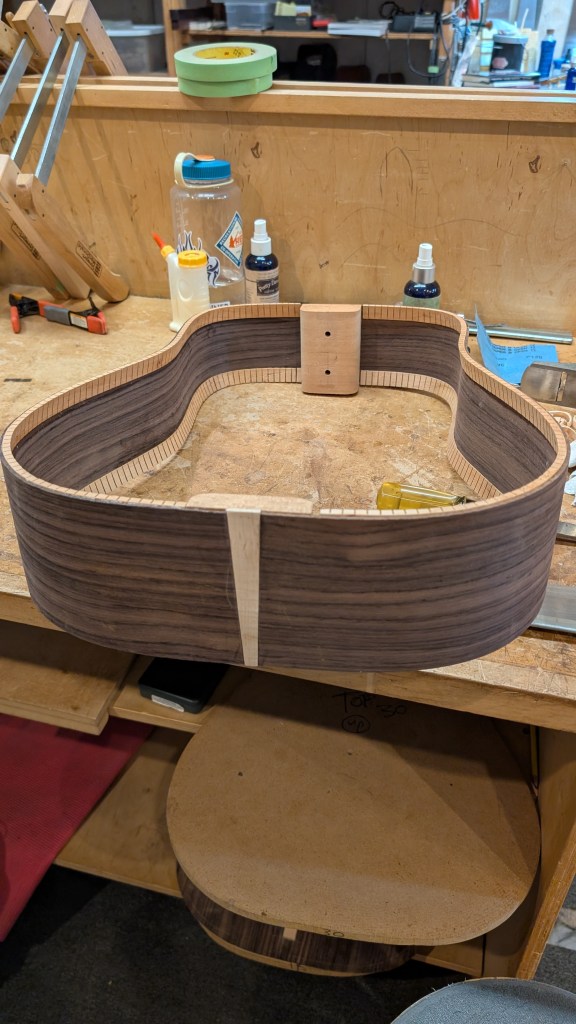
Most of my day is spent sitting before a computer, typing out words or running mathematical models, and that’s just my day job. It’s good work, and I can’t complain about not having to perform back-breaking labor that ages me prematurely day in and day out. Nonetheless, with so much time spent sitting, particularly when including my more stationary ways to pass the time like reading or writing or video games or tv or movies or … you get the gist …, I unsurprisingly find the need for movement. And not just movement of the sport kind (which I love), where movement is in the purpose of getting from point A to point B in a fun fashion while often incorporating a ball of some sort, but also movement of the creative kind. To that end, I’ve been taking a class at the local Colorado School of Lutherie to build my own acoustic guitar. It has been immensely satisfying to say the least. Seeing a guitar form from bits and bobs of wood shaped by my own amateurish hand into something that could fit in on a store rack is great stuff. Highly recommend. The shop and all its instructors are fantastic. I’ve posted a picture from this past week’s class below. Now I wonder if I could someday make a lute. Would be very appropriate to the fantasy world I’m writing for my next novel.

That’s all for today. Looking to increase my frequency of posts by including shorter ramblings. Most will still be directly about whatever science fiction or fantasy story I’ve consumed of late. But others will be like this. Taking a cue from John Scalzi’s Whatever blog I suppose.

All the best,

M. Weald

P.S. At about 20k words on my fantasy novel!

Revelation Space, the circa 2000 science fiction novel by the author Alastair Reynolds, is another book I read based on the recommendation of a friend, the same friend, in fact, who recommended Hyperion by Dan Simmons. These are two very different books, even if they are both science fiction, and they each held within different aspects that stuck with me post they’re reading. No spoilers for either going forward, so fear not words yet unseen.

For Hyperion, it felt an homage to past literary and philosophical greats wrapped in a brilliant science fiction package. The world building, or galaxy building, was great, undoubtedly. But at least for me, it was the characters and their turmoil, their secrets, their joys and pains, that made me need to read on. The interweaving of personal journeys dispensed a story at a time while the crew traveled a truly harrowing pilgrimage pulled at me, so much so by the end I found I didn’t much need to know whether the pilgrimage itself succeeded. I knew what led up to their final destination. I knew the pilgrims. That was enough.

Revelation Space felt a different experience to me, stunning in its own ways. I enjoyed the core trio of characters from whose perspectives the three strands of story intertwined – the xenoarchaeologist Dan Sylveste, the ship weapons master Illia Volyova, and the assassin Ana Khouri – but what made me feel the need to keep reading was the twisty science of it all, the traversing of the labyrinthine maze and the unwrapping of the onion to find one more secret after another. I read that Alastair Reynolds has a PhD in astronomy and worked at the European Space agency for years. That completely fits my perception of him after reading his work. He is clearly brilliant, and wielded that brilliance to create a universe-spanning mythos that felt deeply embedded in our understanding of space and time and all matters of matter. I particularly liked his willingness to keep the speed of light as the currently understood speed limit of the universe. But not just to adhere to that rule, to then make that restriction a key plot element in the intertwining of narrative threads. Without delving into spoilers, the novel opens on Dan Sylveste excavating an alien artifact on the planet of Resurgam in the Delta Pavonis system, looking to uncover evidence that the alien race known as the Amarantin were more than they appeared. This is year 2551. Another thread focuses on the assassin Ana Khouri first found on the planet of Yellowstone in the Epsilon Eridani system in the year 2524. The third focuses on Illia Volyova, a member of a triumvirate on an ancient behemoth of a space ship called the Nostalgia for Infinity, a ship whose descriptions of abandoned sections and decrepit corners lent the book a satisfyingly unsettling bent at times. This thread starts in the year 2540. These three threads and timelines join in a satisfying manner, and the restrictions of sub-light travel across the galaxy plays no small role in that.

To pull it all together, if you are interested in a sci-fi book that leans towards the hard side on the hard-soft sci-fi dichotomy with fantastic worldbuilding and a twisty plot with always another secret to uncover, I recommend a read.

All the best,

M. Weald

P.S. I’m taking a writing class and am now finished with the initial draft of chapter 1 of the fantasy novel that’s been percolating in my mind for years now! I’m aiming to have the initial rough draft ready by the end of April. This time around, I’m hoping to go the traditional publishing route, so that means, among other things, not another 250k word behemoth. I’m planning for this to sit around 80k-100k words. More to come on that later, but just to peak the interest, here is the tagline: When a priestess for human souls left adrift by forgotten gods is taken captive by the worshipers of a rising deity, she must navigate a city splintering under the schism between father and son, a city whose secrets are killing both human and spirit alike.

P.P.S. Side effect of focusing on the novel and well, you know, the job that pays the bills and everything else, means the YouTube channel is largely aspirational at this point. I hope to get back to it, so I’m not taking it down or anything, but I also don’t have any immediate plans to release more there. Regardless, the blog shall continue on! It is undead, stronger than my weak and fleshy self. I will escape whatever afterlife befalls me and come back in servitude to this blog. Forever shall it reign!

I just recently finished watching the Hulu/FX television series Shogun. For those who haven’t seen it yet, it’s an adaptation of James Clavell’s 1975 historical fiction novel of the same name. It tells the story of John Blackthorne, an English navigator who shipwrecks on the Japanese coast in the year 1600 while trying to establish maritime trade with the country, and Yoshii Toranaga, a clever feudal lord (daimyo) trying to navigate an increasingly fraught political landscape. These characters are fictional analogues to historical figures; namely John Blackthorne is a fictional William Adams and Yoshii Toranaga a fictional Tokugawa Ieyasu. I’ve never read James Clavell’s book, nor have I watched the adaptation that was made in 1980, so I came into this series without any real foreknowledge of the story or the real life events that inspired it. After watching this series, I understand why it won all the acclaim and awards that it did (something like 18 Emmys). Put simply, it’s a fantastic show. And it has two more seasons in development.

If you’re still here, all handful of you lovely readers, some other non-spoiler notes. Most of the dialogue is in Japanese, a choice I hope other shows take note of. It seems to be the case that with the rise of streaming and the subsequent accessibility of international shows, the U.S. market has gained a bit more familiarity with, and acceptance of, subtitles. It’s a welcome change to my mind; I don’t see how Shogun could have worked near so well as it did without keeping all of the Japanese. I mean, the story takes place entirely in Japan. With regards to languages beyond Japanese though, namely Portuguese, accommodations were made. John Blackthorne is a Protestant English navigator, but at this point in history it was the Portuguese, the Catholics, who had a stranglehold on Japanese trade. As a result, Portuguese was the lingua franca of the time, the trade language so to speak. Blackthorne knows Portuguese, and as such uses it to converse with the locals and the Portuguese traders and the Jesuit monks. But in the show, while they say they’re speaking Portuguese, they’re speaking English instead; because this is an American production. It works. There was a brief point of confusion in the first episode for me when Blackthorne is speaking English with his shipmates. He talks of speaking Portuguese with their Japanese captors, only to then speak English to the Jesuit monk translating his words ostensibly from Portuguese to Japanese for Yabushige, the local lord of the region where Blackthorne and crew shipwrecked. But after I realized what was going on and got that fixed in my head, there weren’t any subsequent issues. It essentially just amounts to all languages other than Japanese are relegated to English. It felt a fair balance. It still allows for all of the important character work and quirks that derive from being in a foreign country where you don’t know the language and translation is often required, without making things too unfriendly for the general American audience.

But what of other important characters beyond Blackthorne and Toranaga? There are many standouts, and an impressive female cast led by Anna Sawai as Toda Mariko. She serves Lord Toranaga and acts as translator for Blackthorne, given her being a Catholic convert who learned Portuguese from a priest. Her story is brilliantly depicted, tragic in its background and motivation. She is a complex character who does her best to adhere rigorously to feudal era Japan’s idea of honor. She often serves as the sole point of connection between Blackthorne and his surroundings, a translator not just of words but of culture, of the secret heart and self that people bury deep, of hidden ambition, of hidden sorrows, of hidden shame.

Lastly, and this is a heavy topic so feel free to stop here, this show, as my brother further highlighted to me when we talked of it, really explores feudal era Japan’s perspective on death and honor-driven suicide. It’s different than the classical European or American perspective, different from the Christian take that labels suicide a sin. I’m no expert on Japanese culture, so I can’t say for sure on the why of things, but it feels tied to the differing beliefs regarding the afterlife. Ancestor worship in Japan was/is much more prevalent, and along with that the belief that spirits of the dead are tangible and real, existing alongside the living. Whether due to that or the Buddhist beliefs in karma and rebirth, the stigma associated with death, at least for some and in certain ways, feels lessened, though no less tragic. Some characters in the show speak of choosing to die along with their lord, if only to continue in their service, to be with their lord after death. I’m not sure how prevalent that type of action was historically, but I know there are records of it being done. Other times suicide is depicted as the only way to atone for a mistake or damage to one’s honor. It’s a … disturbing take at times, and Blackthorne’s confusion and revulsion is often tangible. Honor is a very human concept; it is complicated and comes in uncountable flavors. And the traps that humanity can lay for itself, the web of responsibilities and lies and truths and expectations, are as myriad and complex as any of humanity’s most impressive technical creations, as the gearing of a watch or the design of a computer’s processing chip. Humanity has ever been good at convincing itself that choice is but an illusion, all too often for tragic or ill-conceived ends. In this show, the strings of ambition and familial bond bind most tightly of all.

All the best,

M. Weald

I read the book Hyperion by Dan Simmons based on the recommendation of a friend who described it as the Canterbury tales in space. It was an intriguing sell to be sure, and I can’t believe it took me so long to get to this incredible tale of interstellar pilgrims coming to meet a metallurgical Lord of Pain seemingly sent backwards through time. Suffice to say I enjoyed it a lot, and I’ll do my best to keep this spoiler free for those who haven’t read it.

So, where to start? John Keats I suppose. I have to admit, I’ve never been much of a reader of poetry. To be sure, I have poetry books on my shelves. But most, if not all, are of the spoken word variety. The likes of George Watsky, Rudy Francisco, Harry Baker, Phil Kaye, and Sarah Kay are the poets whose works I have. And while I enjoy reading them from time to time, I still prefer hearing them spoken, shouted, or whispered as the author intended. All that to say, I don’t know much about classical poetry. I appreciate it, surely, but it’s never quite connected for whatever reason. So, John Keats. I bring him up because his presence is felt throughout this sci-fi novel: from a city named after him on the planet of Hyperion, to the titular planet itself being a reference to the unfinished epic poem John Keats worked on till his death. But the threads go deeper; through characters and plot, Keats’ influence is there. Of course, all of that was lost on me while reading the book. That and a great deal of other literary references. My head is nearly always too busy being stuck in realms of the more fantastical variety. Didn’t catch near a thing till doing research afterwards. So I guess what I’m saying is, you don’t have to know a thing about Keats to enjoy this book. Or a thing about the fine art of poetry, or literary fiction. All I knew was that Keats was a long dead English poet of some renown, but beyond that my knowledge was as blank as the characters’ knowledge of the Lord of Pain’s, the Shrike’s, intentions.

The novel takes place in the year 2732, and the Hegemony of Man exists on planets connected by farcasters, portals that allow for instantaneous travel from place to place. Beyond the Hegemony’s influence are the Ousters, humans who live without gravity on stations floating through the blackness of space. These Ousters also live beyond the influence of the AIs, entities of the TechnoCore who aid the Hegemony. Dan Simmons, the author, does a brilliant job revealing through each of the pilgrims’ stories the intricate web of history and crossed motivations that serve to define each of these major powers, one intriguing detail at a time. I will admit that, as is common for sci-fi novels written before the turn of the century (it was published in 1989), it does take a minute to feel comfortable in Hyperion‘s universe. There is a lot of new lingo and unfamiliar technologies that have to be learned before one’s footing can feel steady, before one can leave assimilating a feel for the environment as a background task so conscious effort can focus on the threads of character and plot. One’s willingness to deal with that is subjective, but I found the process both enjoyable and rewarding in Hyperion‘s case.

As I mentioned in the beginning, this novel was compared to The Canterbury Tales by Geoffrey Chaucer when it was recommended to me, and that predominately comes down to structure. The story unfolds as it follows the seven – an auspiciously prime number – pilgrims as they progress to the Time Tombs on the planet of Hyperion in order to ask a request of the Shrike. While this main arc is occurring, each of the pilgrims tells the tale of how they came to be on their journey, their motivation for meeting a terrifying and deadly being of unknown origin as interplanetary war looms large. It is through these tales that the universe is described, through the lens of these diverse pilgrims. I won’t tell their stories here, for it would only be a pale imitation, but suffice to say each of their tales is illuminating. The final particularly so. Humans act as humans will, and if the past is any indication, the march of humanity across the stars will mostly likely contain many of the same foibles expansions of kingdoms and dynasties on this Earth have held. The book’s ending was unique. Satisfying and reflective. But perhaps most intriguingly, not at all in the way I had expected. I know there are more in the series. Undoubtedly I will read them someday. But for now, I think I’ll just reflect on Hyperion for a spell. That and try to whittle down my to be read list one book at a time of course.

All the best,

M. Weald

I’ve been working my meandering way through books I feel I should’ve read years back. ‘Salem’s Lot is one of those, especially considering how much I’ve long enjoyed Stephen King (see https://mweald.com/2024/05/31/on-fairy-tale/ for more on that). So, what to say on this well-known tale of blood-sucking vamps? First off, surprise surprise, it was a fun read. Secondly, beyond the usual strengths of any Stephen King novel set in a small, nearly forgotten town in rural Maine, I quite enjoyed King’s take on vampires, always have. Their evil is shown as ancient and outside the boundary of any modern or known religion. The usual wards and tools work, crosses and holy water and the rest, but out of an innate desire to rid the world of an evil that drew breath before any Abrahamic figure was born, not out of specific ties to a human held deity. A vampire is the raw stuff of evil, and as such can be combated by a belief in something greater distilled. That take has always resonated with my agnostic self. There is a description towards the end of the book that really brought this idea home. It takes place as one of the main characters, the writer Ben Mears, swings a hammer as a man possessed, attempting to break through to the evil vampire Barlow before time runs short. ” … the possession was not in the least Christian; the good was more elemental, less refined … It was Force; it was Power; it was whatever moved the greatest wheels of the universe.” Good stuff, that.

This wasn’t the first time I’d encountered vampires in Stephen King’s oeuvre; I believe that honor goes to The Dark Tower series. But I think of ‘Salem’s Lot as a sort of origin story for King’s take on the vampire mythos, and I believe I have some grounds for that notion. ‘Salem’s Lot was published in 75′, years before the first of The Dark Tower series was published in 82′, and even longer before we get a more complete breakdown of vampire types in The Dark Tower V: Wolves of the Calla, published in 03′. I can imagine the gears of King’s mind working over the intervening years. And of course, we see the introduction of Father Callahan in ‘Salem’s Lot, the Catholic priest whose redemption comes in The Dark Tower as a member of Roland Deschain’s second ka-tet. I wish I would have read ‘Salem’s Lot all those years ago before I read The Dark Tower. It would have made Callahan’s arc all that more impactful. Nonetheless, I’ve read it now, and for that I’m grateful.

Of course, ‘Salem’s Lot is a King book, and that can tend to indicate a couple things. King is a master at creating a sense of place so detailed it becomes a character unto itself, at creating characters both to love … and to hate (i.e. Big Jim in Under the Dome). Some of those depictions of characters to hate, or even just dislike, what with their casual comments of racism, homophobia, or misogyny all the way to actions bloody and violent and heinous, are (at least as far as the slurs) unfortunately not out of place for the setting, and at times tough to stomach. There is an argument to be made that the usage of such backwards views to engender dislike of certain characters can be a bit heavy handed in King’s earlier works, but that terrifying ability of King’s to show otherworldly depravity in the mundane and familiar is also what has kept readers coming back again and again. Some of King’s works can have inconsistent pacing – looking at you middle half of The Stand – but I didn’t see that here. If anything, I actually thought ‘Salem’s Lot could’ve been longer. The only thing that stuck out as a pet peeve of mine was the treatment of Ben’s girlfriend Susan. A bit of fridging there it felt like. Google “fridging” as a literary trope if that doesn’t sound familiar. Wish Susan could have had a bit more agency. Nonetheless, I greatly enjoyed reading ‘Salem’s Lot and think it’s cultural significance well-deserved. King’s descriptions were, as always, both interesting and unsettling in that way only he can achieve.

All the best,

M. Weald

There’s been a welcome shift in popular culture over what feels like the past 5-10 years, a recognition that the animated medium of storytelling shouldn’t just be relegated to children’s tales, something Japan recognized years ago. Not that there aren’t incredible family friendly animated stories like Disney’s Up that I’ll keep coming back to till the day I die. Or the recent Puss in Boots: The Last Wish. That movie has no right to be as good as it is. But I feel that my generation, or perhaps just myself, watched Avatar: The Last Airbender back in the mid to late 2000’s and then never stopped asking for animated tales that grew with us, tackling ever more mature topics with the ingenuity and openness drawn worlds can provide. Though I will say Avatar: The Last Airbender ages like that perfectly soft hoodie: it’s a comfort I’ll keep coming back to even as the DVD’s start to wear with use. And then I’ll just stream it. But as a millennial working hard at adulting, I’m grateful to see a profusion of complex, deep and dark tales sketched onto the screen. In the modern streaming landscape, it started for me with Castlevania. What an incredible show. Impressive worldbuilding and character depth along with insane fight scenes rivaling the best the medium has to offer. Since then we’ve gotten Arcane, Blood of Zeus, Blue Eye Samurai, The Legend of Vox Machina, and Invincible, just to name a few. This is before going into the influence of Japanese anime, a genre that isn’t without its overly indulgent fan service and myriad other, at times frustrating, quirks. But anime is nonetheless a seminal subset of the medium with entries I adore. Ghost in the Shell was a significant source of inspiration for my novel. Oddly enough so was the Studio Ghibli classic Spirited Away, even if it is quite a different setting and subject matter. But if there is any common thread in all of the aforementioned animated stories, it’s that they took advantage of the medium’s greatest strength: a blank canvas that doesn’t need to mesh real people with CGI to tell a fantastical tale through the lens of the mind’s eye. Scavengers Reign did that in spades, and then some.

I won’t give any spoilers for Scavengers Reign, but then again I’m not even sure I could spoil the greatest aspect of it in a written blog. The art is otherworldly and capricious and mysterious and stunning. The basic premise as could be found in any blurb for the show is that a space freighter named the Demeter has crash landed on an alien planet. That’s as much as I’ll say plot wise. The planet, with it’s unique and unfamiliar ecology, microcosms of life and death and everything between, sets the show apart. Along with the characters, you experience that which is both unsettling and beautiful. My only sadness is that the second season remains uncertain. First Max canceled the show not too long after it aired, then Netflix gave it a trial period to see if it warranted more episodes. Now who knows, though it does seem likely the first season is the end even with the Emmy nomination. Either way, it’s well worth a watch. It tells a complete story in it’s first and perhaps only season, even if I can’t help but hope we see the seeds planted for further adventures on that terrifying world bear fruit.

All the best,

M. Weald

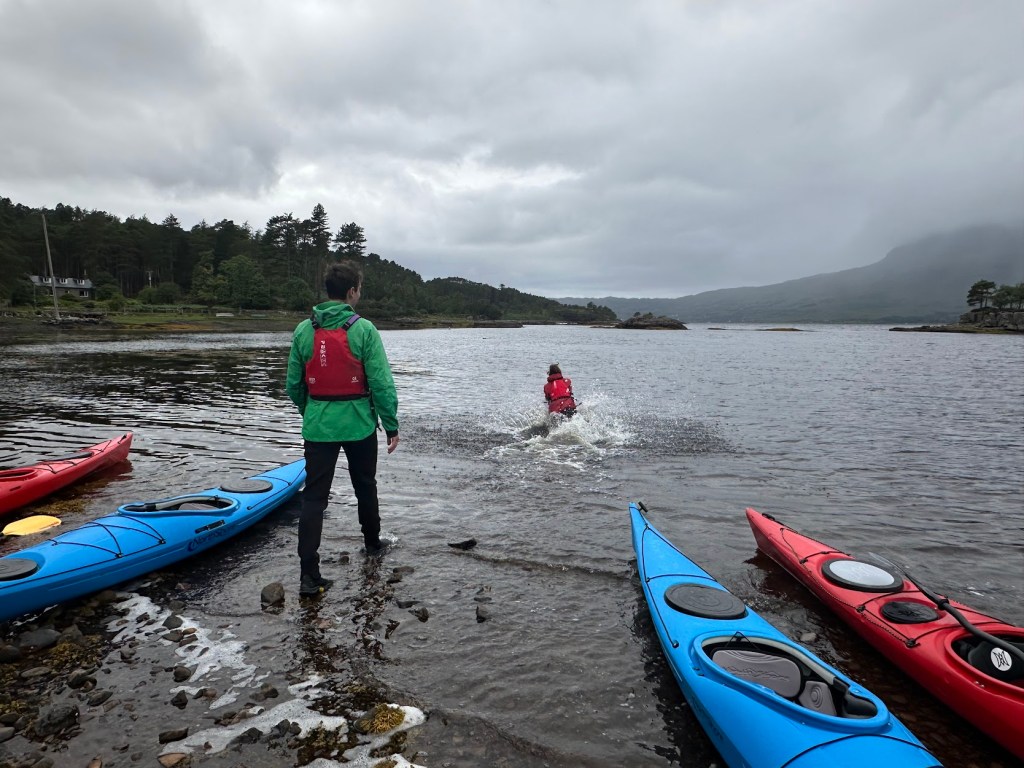
I’m in the airport on my way back to Colorado after finishing up a family vacation in Scotland. Figured I’d share a particular highlight. This is us after kayaking Loch Torridon in what may not look like good weather but was a welcome break from otherwise steady rain. I’m hesitantly following Courtney into what I promise you was very cold water. My parents and sister are behind the camera, understandably unwilling to take the plunge.

All the best,

M. Weald

The amount of fun I’m having playing the video game Baldur’s Gate 3 reminds me of when I first played Dragon Age: Origins way back in 2009. BioWare seemed to have poured its collective heart and soul into developing DA: O back in the day, even if BioWare’s more recent entries have been a tad more hit or miss for me. I know I’ve put well north of a hundred hours and multiple playthroughs into DA: O. It truly felt like a tabletop roleplaying game akin to Dungeons and Dragons distilled into video game form. Its free use of a pause system made it’s combat turn-based adjacent, and the setting was one familiar to any fan of high fantasy with ample quirks and flairs to make it unique, a testament to David Gaider’s work. The companions were a particular highlight. I did a Morrigan romance in my main campaign. Who doesn’t love a shapeshifting witch of the wilds? Even if she did need a bit of an introduction to empathy. Pragmatic to a fault that one. I gotta give a shout out to my boy Alastair as well, ex-templar and rightful king. And Leliana. In any case, I seem to have gone a bit afield. Point is, as much fun as I had playing Dragon Age: Origins, Baldur’s Gate 3 seems to be eclipsing it.

All of the strengths I mentioned above with regards to DA:O are just as applicable to BG 3, with even more besides given BG 3 actually takes place in the D&D universe known as the Forgotten Realms. As someone who currently DM’s a weekly D&D campaign, Larian somehow managed to capture the most of elusive of things: the absolute chicanery and chaos that comes from a table of friends letting their imaginations run wild. The amount of leeway the developers give the players to sweet talk or intimidate or outwit only to have their plans quite rudely interrupted by a natural 1 rolling of the die resulting in unintentional murderhobo is D&D at its zaniest. I’m currently playing a longbow focused wood elf beast master ranger who sends his tanky bear Ursa into the fray while expertly cutting down marked prey from afar. Ursa is best bear and I can’t wait for Ursa to get an armored hat. The eternally gloomy Shadowheart, the earnest and unintentionally hilarious Lae’zel, and the loquacious yet distant mage Gale round out my typical crew. I’m in the middle of Act 1 and swap out Lae’zel for Wyll or Astarion depending on the questline. With how long it has taken me to get as far as I have, I can only imagine how many hours are going to get sunk into this game. Here’s to hoping I can stay productive with all the other things I want to do. And now, back to Baldur’s Gate to sneak into a goblin camp.

All the best,

M. Weald

P.S. I would be amiss not to mention that my character’s name is Cheeseburger. My first ever D&D character was a ranger named Cheeseburger with a wolf companion named Fries. My DM loved me…

If I’d been asked to pick my favorite author during high school, it probably would have been Stephen King. I read my fair share of his horror classics during this time: The Stand, The Shining, It, The Long Walk, Cell, Under the Dome, etc. I grew up amongst the corn fields of southern Indiana and something about this devil-at-the-crossroads Midwest pastiche demanded some flavor of emo out of pretty much everyone. For many that meant a long fringy black haircut, black clothes, black nail polish, skinny jeans, and a general air of existential fatalism. For my nerdy self, it meant reading Stephen King’s very specific style of the small town macabre well into the night … and long fringy brown hair, skinny jeans, and a penchant to listen to My Chemical Romance. All that aside, my favorite out of his many works has to be his era spanning fantasy epic: The Dark Tower Series. On those occasions when he dipped into the world of fantasy, his descriptions of the grim and gory melded with my earliest literary love of heroic fantasy to become something new to my young high school self. At the time, it felt like only those who truly liked Stephen King even knew of his Dark Tower novels, his magnum opus hidden behind his much better known aforementioned horror hits. I recall after finishing book 7 and closing the door on the story of gunslinger Roland Deschain, I searched through his bibliography hoping for more of the same. I found his book The Eye of the Dragon and read that right away. Soon after that the The Wind Through The Keyhole was published. Still, none of it’s ever quite fully scratched the itch. My reading habits are more varied, at least in terms of authors, these days, but I still keep an eye out for any new Stephen King release. Especially one of the fantasy variety. So, you can imagine my excitement when I heard tell of Fairy Tale.

With a name like Fairy Tale, I would have been sorely disappointed had it not included a fantastical, medieval adjacent realm filled with unknown magics needing to be set aright. Thankfully, the book well and truly followed through on the name’s promise. It is even told with the air of one sitting at a campfire, relaying an adventure of their past. In this case, the narrator is an older Charlie Reade, relaying his difficult childhood and subsequent journey to another realm. At this point, I’ll give a minor spoiler warning. Nothing major, just hints and clues and what’s already written on the back of the book. In any case, Fairy Tale lives up to its name. It is chock full of references to fairy tales from the particularly important Rumpelstiltskin all they way to a more modern fairy tale like The Wizard of Oz, and it follows the general arc of one well enough itself. It begins with a young Charlie Reade talking of that “goddamn bridge”, the site of his mother’s early death from being struck by a van. His father drinks to cope and loses himself for awhile, a young Charlie losing himself in acts of juvenile delinquency with his friend Bertie Bird. Eventually, Charlie’s father, George, gets sober with the help of a friend and an AA program. Charlie too, above all grateful for his father’s newfound sobriety (though not without his own scars and misgivings on his father’s past actions) gets on the straight and narrow. It is after a bit of time on this road of recovery we see young Charlie meet an injured Mr. Howard Bowditch and his dog Radar. Let’s just say Howard is a taciturn old man with secrets aplenty and Radar his aging German shepherd whom Charlie immediately recognizes as the goodest of bois (To put it another way that doesn’t use internet slang, he loves that dog right away). One of those pesky secrets of Howard’s includes a shed in the backyard, one from which occasionally emerges a rather disturbing noise. Since it is expressly written in the blurb of the book, I’ll describe this shed as akin to a certain wardrobe of fantastical renown. Through it, Charlie will go to another realm to learn a bit of wisdom, experience a bit of that Stephen King macabre, and return to the world a changed young man. If I had to pinpoint that bit of wisdom that Charlie learns, it would be the age old lesson that love can be a powerful thing. Oh, and names. Names can be powerful too. I give this book a hearty recommend.

P.S. In writing this post I realized I somehow completely missed the existence of King’s Dark Tower adjacent books The Talisman and Black House. So that’s a bit of egg on my face. And my TBR just got two books longer.