
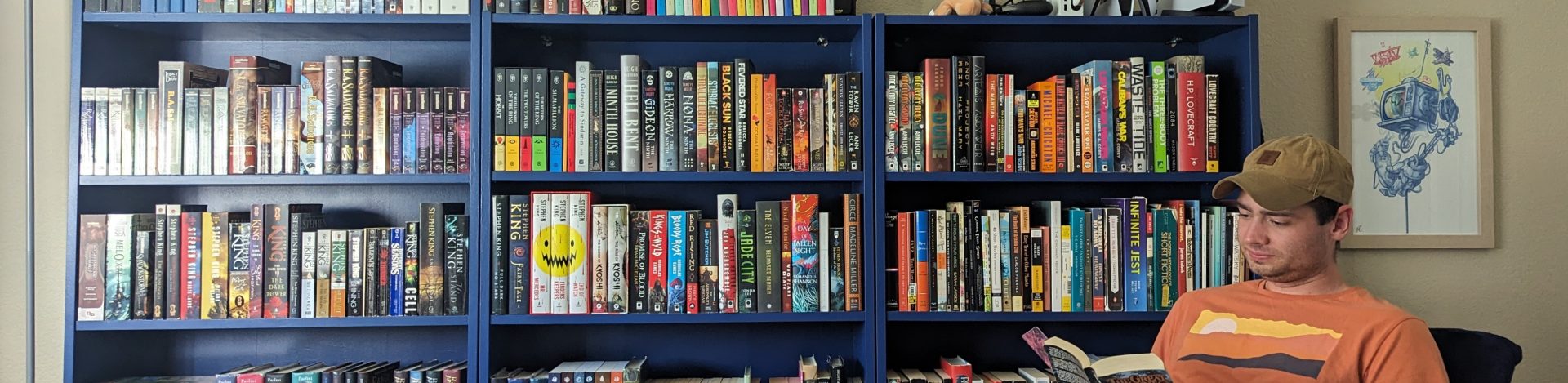
I was told by a friend who’s already passed the somehow both meaningful and yet meaningless benchmark that is 30 years since entering this world naked and screaming that both my muscle strength and bone density would halve at midnight. I don’t believe that happened, but then again perhaps one’s mental faculties also drop in half and as such I can no longer discern the accuracy of that statement. Jokes aside, as anyone would realistically expect I feel much the same, and given the alternative to having a birthday is death, I’ll take what comes for as long as I possibly can. As Hob Gadling in Neil Gaiman’s Sandman series says upon Dream’s asking if he still wishes to live after spending the past 80 years of his immortal life utterly destitute, “Death is a mug’s game. I got so much to live for.”
Now on to something completely different, namely that of the missteps of the executives of Wizards of the Coast who, as is becoming increasingly apparent, aren’t much in the way of gamers themselves. There are countless breakdowns on YouTube and various blogs by those much more informed than I of the leaked OGL 1.1 license, so I won’t wear out a well-worn path even further. Suffice to say for those who are unaware, Wizards of the Coast, a subsidiary of Hasbro, is the company that owns Dungeons & Dragons, the ubiquitous tabletop role-playing game whose popularity has been surging over the past few years, in no small part due to the pandemic. OGL stands for open gaming license, and OGL 1.0a was the license under which a thriving tabletop RPG ecosystem was fostered. Similar in spirt to the creative commons license, it let the community use the D&D framework to make and publish their own creations. Let’s just say Hasbro and in turn Wizards of the Coast has seen all that has been created and instead of being a responsible steward, decided it was time to take what they claim is theirs. It’s been a saga of rollbacks and questionable PR statements since. As someone who has been playing tabletop RPGs for almost 15 years now, typically D&D, and is currently the DM for a D&D campaign, I might have to dip back into the world of Pathfinder. Paizo, the company behind Pathfinder, seems a much more trustworthy sort, and their announcements surrounding a new, irrevocable, gaming license are very welcome news.
On to the next topic, that being Witcher: Blood Origin. I’m not typically one to say anything negative, but it’s … not good. It had so much potential to explore an oft referenced but previously unexplored historical event in the novels: the conjunction of the spheres with the coming of humans and monsters to the world. As a fan of the novels, I’ve been concerned with much of the recent press surrounding the live action Netflix adaptions (see last November’s post) and the rumors surrounding some of the writers’ distaste for the source material, so I came in with low expectations anyway. It’s not that I don’t believe an adaptation can’t stand on it’s own as a unique piece of art, distinct from its source material, but rather that adaptions at the very least need to understand why the original worked. In the end, it would seem I should have set my expectations lower still. While the set design and action choreography are fun at times, the talents of the cast are wasted on an unfeeling script and utterly nonsensical world building (see end of first episode). There were multiple scenes that just felt … off. Scenes that should have been good, yet lacked any meaningful motivation or buildup. One major miss that only highlights how far off the rails things went is that the ancient elven culture is distinctly … normal … and boring. It is a human medieval society like so many others in fantasy. They just slapped long ears on humans and thought, meh, good enough. To be honest, I haven’t managed to get myself to watch the last episode, and I’m not sure if I ever will.
Let’s end on a high note. I’ve started my read through of Rhythm of War, the fourth book in Brandon Sanderson’s Stormlight Archive, and I have to say, Brando Sando’s done it again. While perhaps not my favorite in the series, that might be Oathbringer, it’s another solid entry. As the internet has long posited, the man must be a machine. I’ll have more thoughts on it once I finish, but until then, I recently finished The Enchanter’s Counsel by Thalib Razi, an indie fantasy novel that deftly blends seldom seen cultures in fantasy to tell a fun and socially relevant story. I actually went to school with Thalib at Purdue during my undergraduate studies. While I’m agnostic and he Muslim, I always enjoyed our conversations. I see the same welcoming, inquisitive, compassionate mind at work in his novel. Recommend a read.
That’s all for now. Until next time.
M. Weald
P.S. I just hit the 80% mark on the final edit of my novel! Still hoping to publish here in the next few months. More updates to come.
 M. Weald